Author: Hong Kong

  • Simulation der Entgasung von Flüssigkeiten mit OpenFOAM

    Simulation of Gas Removal from Liquids with OpenFOAM

    Lack of space and high cost pressure ultimately lead to increasingly complex and smaller hydraulic tanks. This results in a drastic reduction of air separation in the tank – and thus to an increased amount of free air in the hydraulic system.

    In hydraulic systems, free air remains a technical challenge today. As long as the air is dissolved in the oil, it does not alter its properties.

    Unresolved air, i.e., air bubbles, cause:

    Corrosion on pumps and controls
    Reduced efficiency of pumps and hydraulic motors, increased compressibility and thus possible jerky movements in the drive. In addition, there is 

    • Accelerated oil aging
    • Noise increase
    • Damage to components (e.g., cavitation)
    • etc.

    Air enters the system during assembly, through leaks in the negative pressure area, and when oil flows back into the tank. Depending on the separation efficiency of the filter-tank system, the air rises slowly in the tank and is drawn back in by the pump.

    Simulation in Air-Liquid Tanks

    Silentdynamics uses InsightCAE to perform a series of simulations of dispersed gas bubbles in a degassing tank. The application of the solver twoPhaseEulerFoam enables the unsteady-state tracking of the gas phase, integral values of air at the outlets, and the overall quality of the degassing device. 

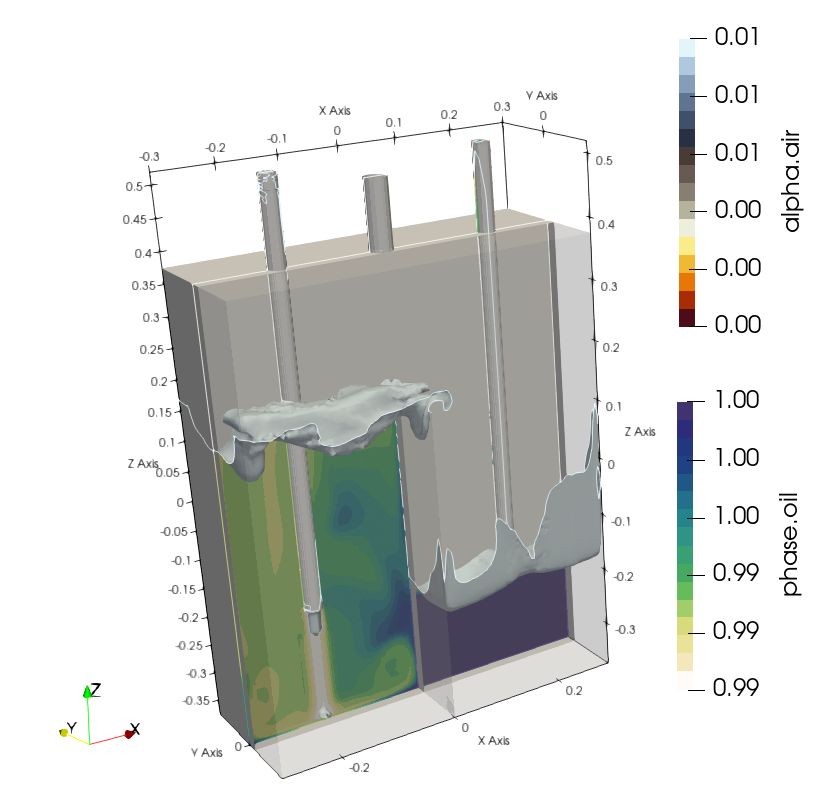
    As an example, a simple degassing example is presented. One inlet and two outlets, including a wear plate in the middle. The oil-gas mixture moves over the wear plate for degassing.
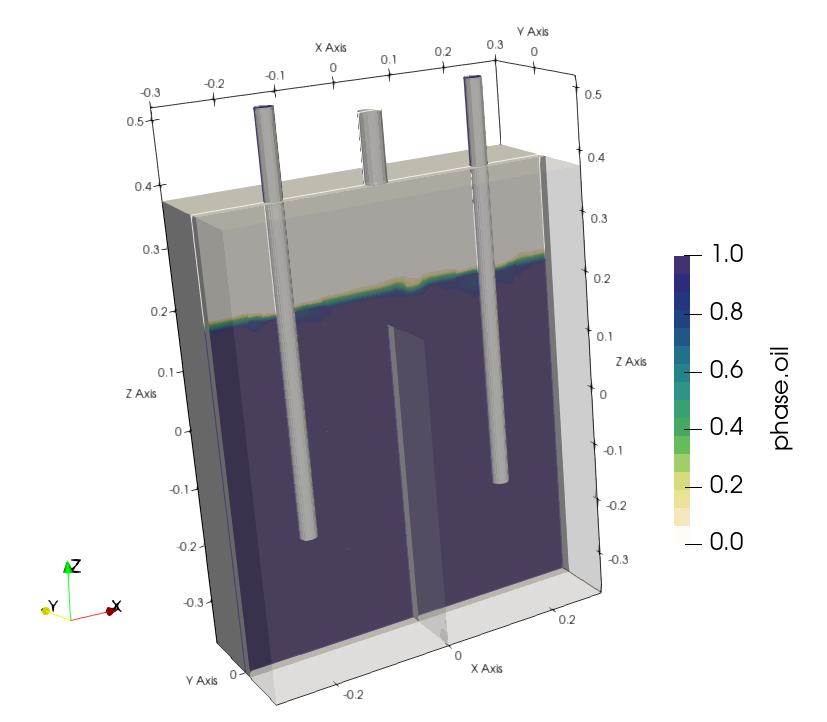
     

    After setting the gas-oil dispersion boundary conditions such as gas bubble size, mixing coefficients, phase properties, etc., the simulation was able to proceed with twoPhaseEulerFoam to be started.

    Using the advanced solver settings within InsightCAE allows for large time steps to be taken, enabling simulations to be completed in a reasonable amount of time.

    Iso-surfaces of at a gas phase fraction of 1%.


    The modification of the degassing tank's geometry using numerical simulation leads to a sufficient degassing process of the hydraulic oil.

  • Simulation Elektronik Kühlung mit OpenFOAM

    OpenFOAM Electronic Cooling Simulation

    Limited space and high power consumption ultimately lead to an innovative cooling design for a wide range of PCBs. The arrangement of power supplies, the dimensions of heatsinks, and the design of the outer casing are gaining importance. Thermal simulations during the PCB design process help to avoid overheating problems in the later production phase. 

    Different materials, the combination of heat conduction, convection, and radiation in solids and air result in a rather complex thermal simulation. Setting material properties, boundary conditions, solver settings, and coupling areas often takes a significant amount of time.

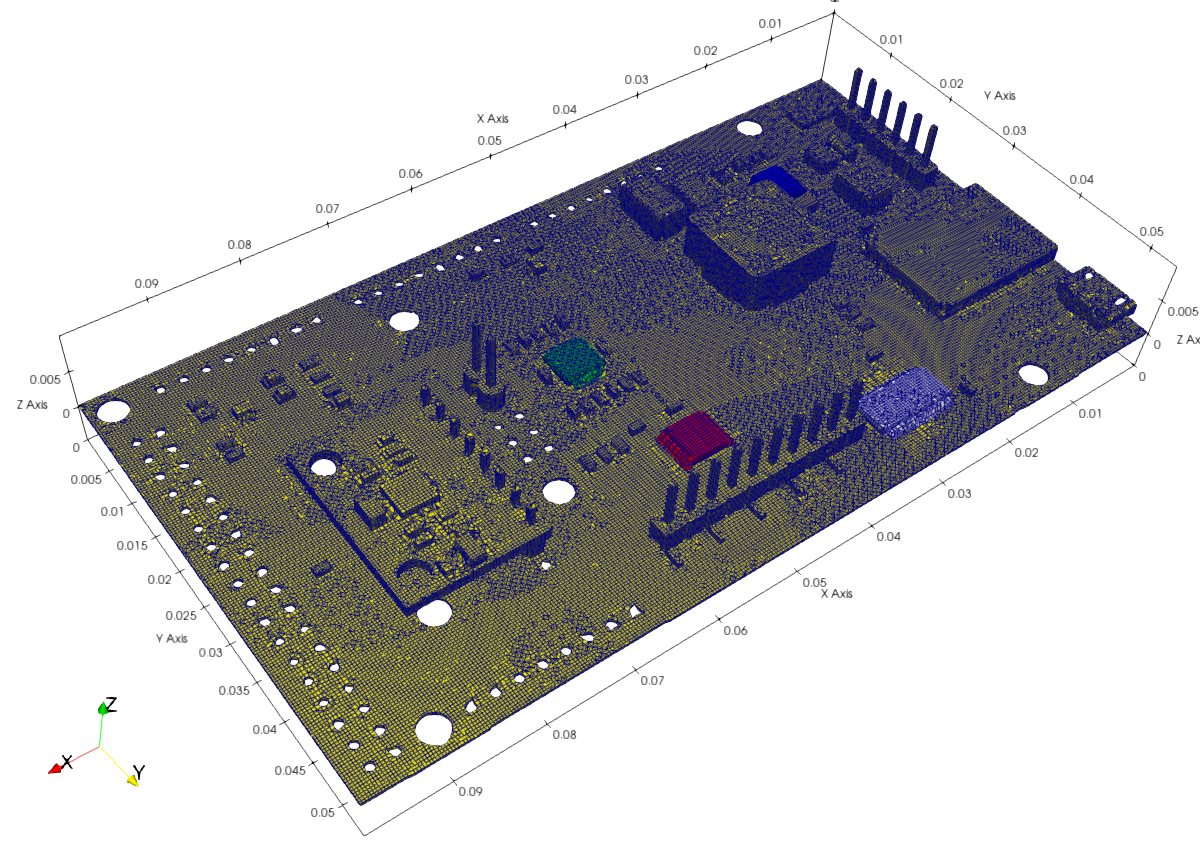
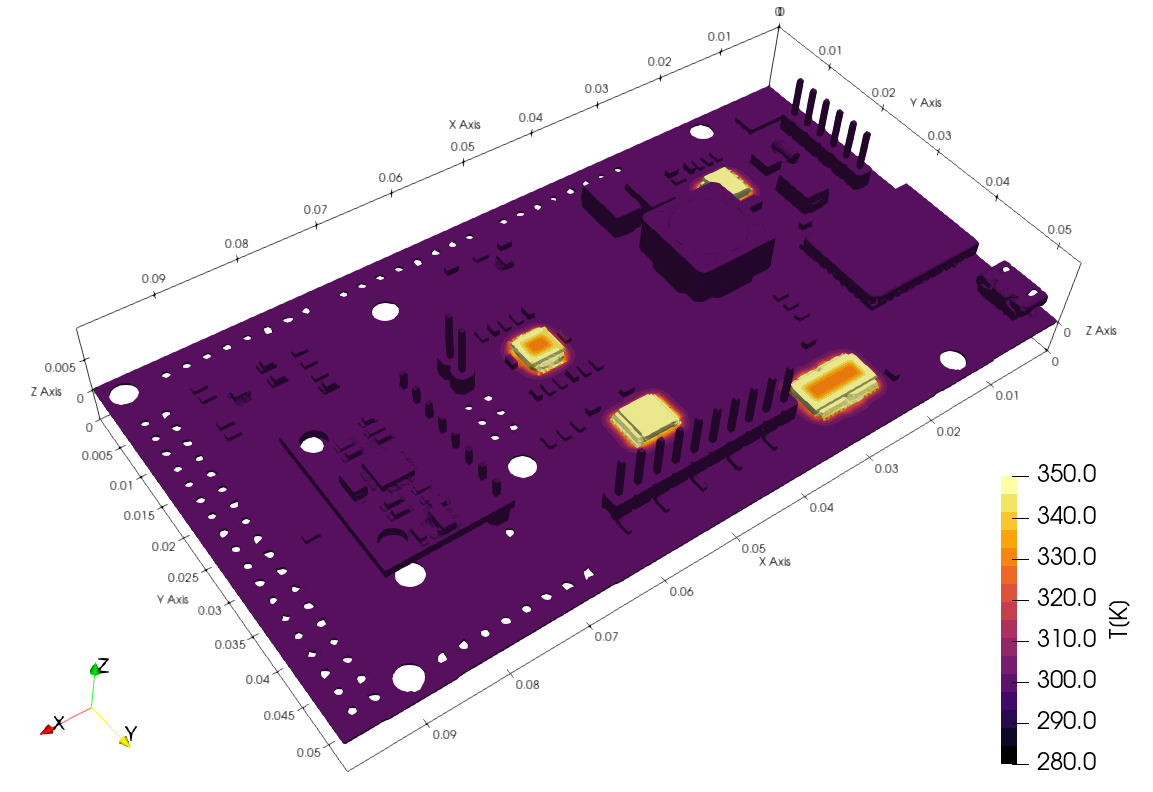
    As an example, a typical printed circuit board (PCB) with its components is presented.

    Thermal simulation 

    Silentdynamics managed to set up the simulation using OpenFOAM thermal solvers (chtMultiRegionFoam, chtMultiRegionSimpleFoam) to bundle within the InsightCAE framework for rapid preprocessing.

    The import of CAD files for each component and the optimized process of parallel meshing of the regions with snappyHexMesh are essential for the conservative thermal coupling of the different regions.

    Please note that the use of different Vias, copper wires, thermal interface materials, or other heat-related points must be considered in the simulation model. With the help of region modeling, CellSets, and layer definitions for each component, all necessary thermal properties can be taken into account.

    The ability to define special placeholders makes the setup of the CHT simulation nearly automated. 

    Furthermore, improved treatment of thermal radiation and optimized solver settings form the basis for stable and convergent simulations. 

  • Electronic cooling simulation using OpenFOAM

    Electronic cooling simulation using OpenFOAM

    Space limitations and high power supply requirements ultimately lead to innovative cooling designs for a wide range of PCBs. The arrangement of the power supply, heatsink dimensions, and the design of the outer housing become more important. Thermal simulations within the PCB design process help to overcome overheating problems in later production stages. 

    Different materials, the combination of heat conduction, convective, and radiative heat transfer within solids and air result in fairly complex thermal simulations. Setting up material properties, boundary conditions, solver settings, and coupling regions often takes a considerable amount of time.

    As an example, a typical PCB with its components is presented.

    Simulación térmica 

    Silentdynamics has managed to bundle the simulation setup using OpenFOAM thermal solverschtMultiRegionFoamchtMultiRegionSimpleFoamwithin its framework InsightCAE for fast preprocessing.

    Importing CAD files for each component and its optimized parallel region meshing process using snappyHexMesh are essential for the conservative flux coupling of the different heating regions.

    Notice that the usage of different Vias, copper wires, heat conduction layers, or other heat-related points needs to be addressed in the simulation model. Using region modeling, cell sets, and layer definitions for each component allows for the consideration of all required thermal properties.

    Allowing for specially defined wildcards, CHT simulation setup is nearly automated. 

    Moreover, improved heat radiation handling and optimized solver settings form the basis of stable and convergent simulations. 

  • Degassing simulation using OpenFOAM

    Degassing simulation using OpenFOAM

    Space limitations and high cost pressures increasingly lead to more complex and smaller hydraulic tanks. This results in a dramatic reduction of air separation in the tank and, consequently, an increased amount of free air in the hydraulic system.

    In hydraulic systems, free air is still a technical challenge today. As long as the air is dissolved in the oil, it does not change its properties.

    On the other hand, undissolved air, i.e., air bubbles, cause:

    • Corrosion on pumps and controls
    • Increased compressibility of hydraulic fluid can reduce the efficiency of pumps and hydraulic motors, leading to possible stuttering movements of the output member.
    • Accelerated oil aging
    • varnish noise
    • Damage to the components (e.g. cavitation)
    • etc.

    Air enters the circuit during assembly, through leaks in the negative pressure zone, and as oil flows back into the reservoir. Depending on the separation capacity of the filter-tank system, the air in the tank only rises slowly and is then re-sucked by the pump.

    Simulation of air-liquid devices

    Silentdynamics uses InsightCAE to perform a number of simulations of dispersed gas bubbles in a degassing tank. Application of the solver twoPhaseEulerFoam enables the transient tracking of the gas phase, integral values of air at the outlets, and overall the quality of the degassing device. 

    As an example, a simple degassing scenario is presented. There is one inlet and two outlets, with a weir located in the center. The oil-gas mixture flows over the weir for degassing.


    Setting up gas-oil dispersion boundary conditions such as gas bubble size, blending coefficients, and phase properties for the simulation using twoPhaseEulerFoam could be initiated.

    Using advanced solver settings within the InsightCAE framework, large time steps are enabled to manage simulations within a reasonable timeframe.

    Isosurfaces of 1% gas are presented. 


    Changing the degassing tank geometry using numerical simulation leads to a sufficient degassing process of the hydraulic oil.
  • Vector Calculus in Bash Scripts

    When performing preparatory operations for CFD or FEM analyses, for example, it is often necessary to specify vector parameters. Vector constants are easy to handle:

    myMesh --direction "$1 0 0"

    However, it quickly becomes complicated if the vectors have to be manipulated, e.g. multiplied by scalars or rotated.

    A powerful solution is to use the Matlab Octave clone to perform the operations. Two features of Octave are useful in this context:

    • the command-line option “--eval” to specify the expression to handle
    • The `disp` function outputs results in a plain format on a single line.

    Here's the translation: An example:

    DIR="1 0 0"
    VELOCITY=$(octave --eval "disp( 11.*[$DIR] )")
    
    myMesh --direction "$DIR"
    mySolver --velocity "$VELOCITY"

    More complicated operations are possible, though one needs to take care to produce line vectors as results. Rotation is an example:

    DIR="1 0 0"
    ANG=45
    
    DIR_ROT=$(octave --eval "pkg load linear-algebra; disp( (rotv([0 0 1], $ANG*pi/180)*[$DIR]')' )")
    
    myMesh --direction "$DIR_ROT"


  • Exporting a STEP file with named surfaces from PTC Creo

    Exporting a STEP file with named surfaces from PTC Creo

    When preparing geometry for numerical simulations, it is often required to mark individual surfaces in the model. These surfaces can then be used, for example, as an inlet or for applying forces and pressures in a structural simulation.

    The STEP format supports named entities. The question is: how to set the names in the CAD program? And how to achieve that they are actually stored in the STEP file? In the following, these questions are answered for the software PTC Creo.

    Name Surfaces

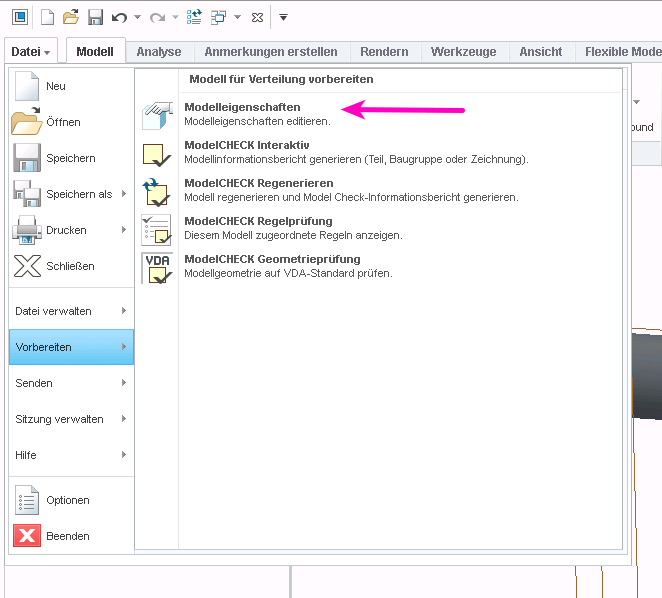
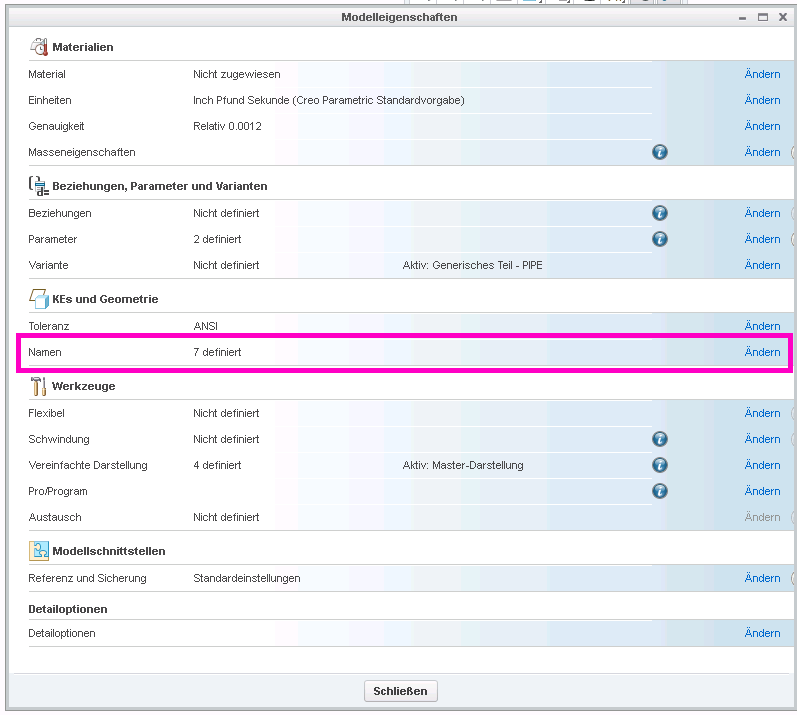
    Select “File” > “Prepare” and then “Open Model Properties”, then select “Names” in the model properties dialog:


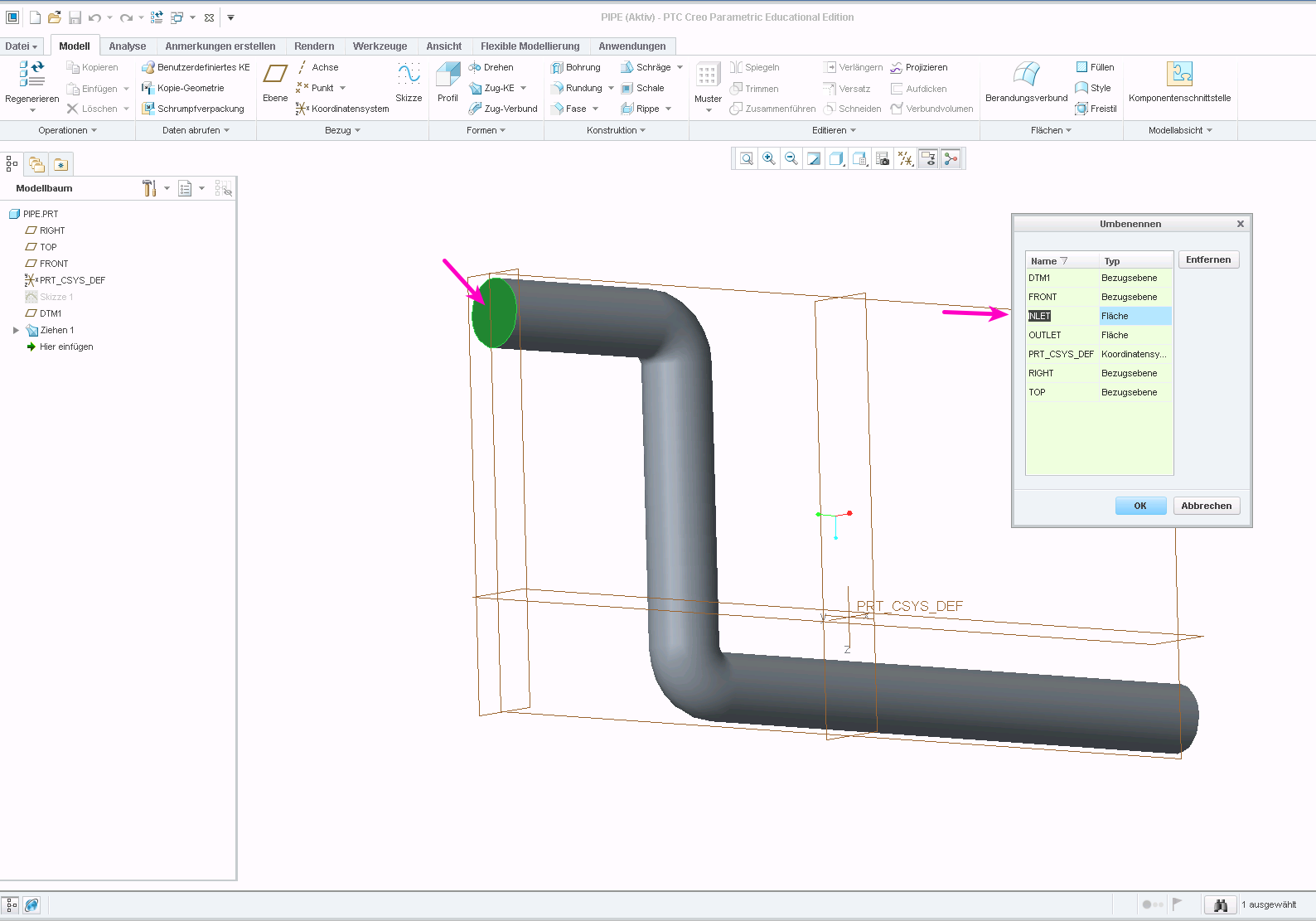
    You can then select faces by clicking on them and enter a name in the dialog box:

    PTC Creo assign name to face or surface

    Exporting Names in STEP File

    If you export an STP file with the default settings, the names will not be stored in the file. You need to change the export setup for them to be kept.

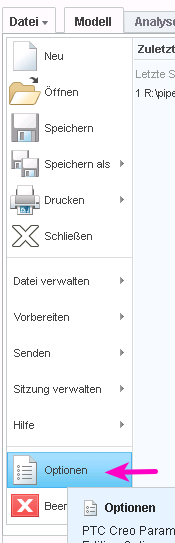
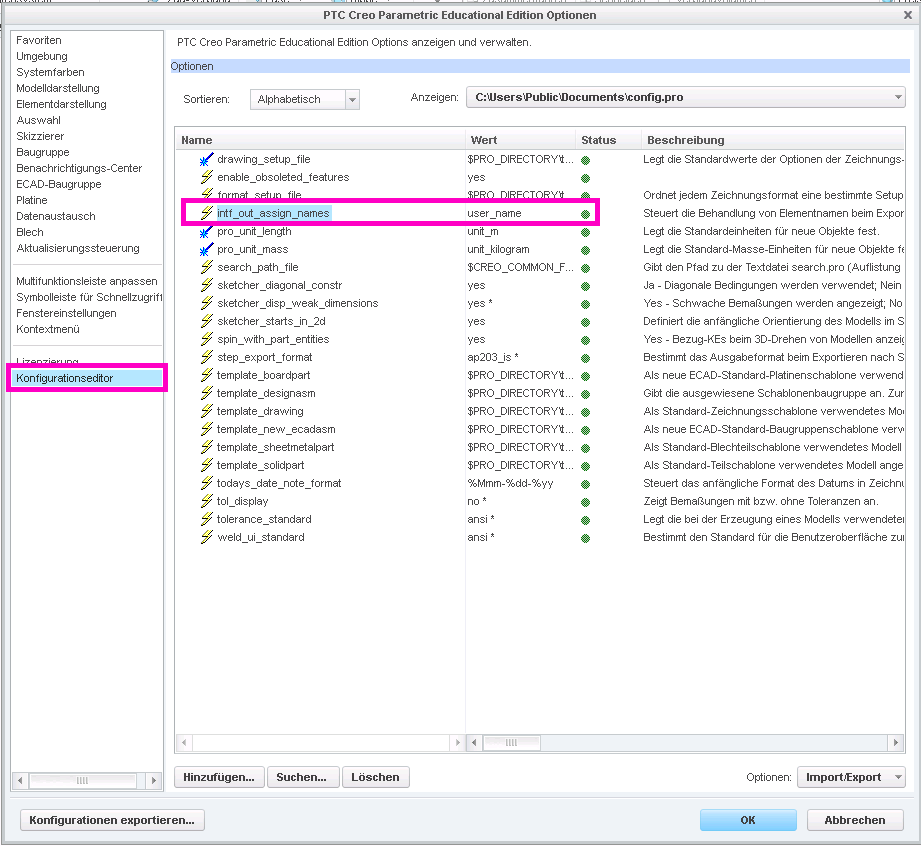
    Open the settings dialog via “File” > “Options”. Then navigate to “Configuration Editor”. Here, you need to add the option “intf_out_assign_names” and set it to “user_name”.

    PTC Creo STEP export settings

    Accessing Named Entities in ISCAD

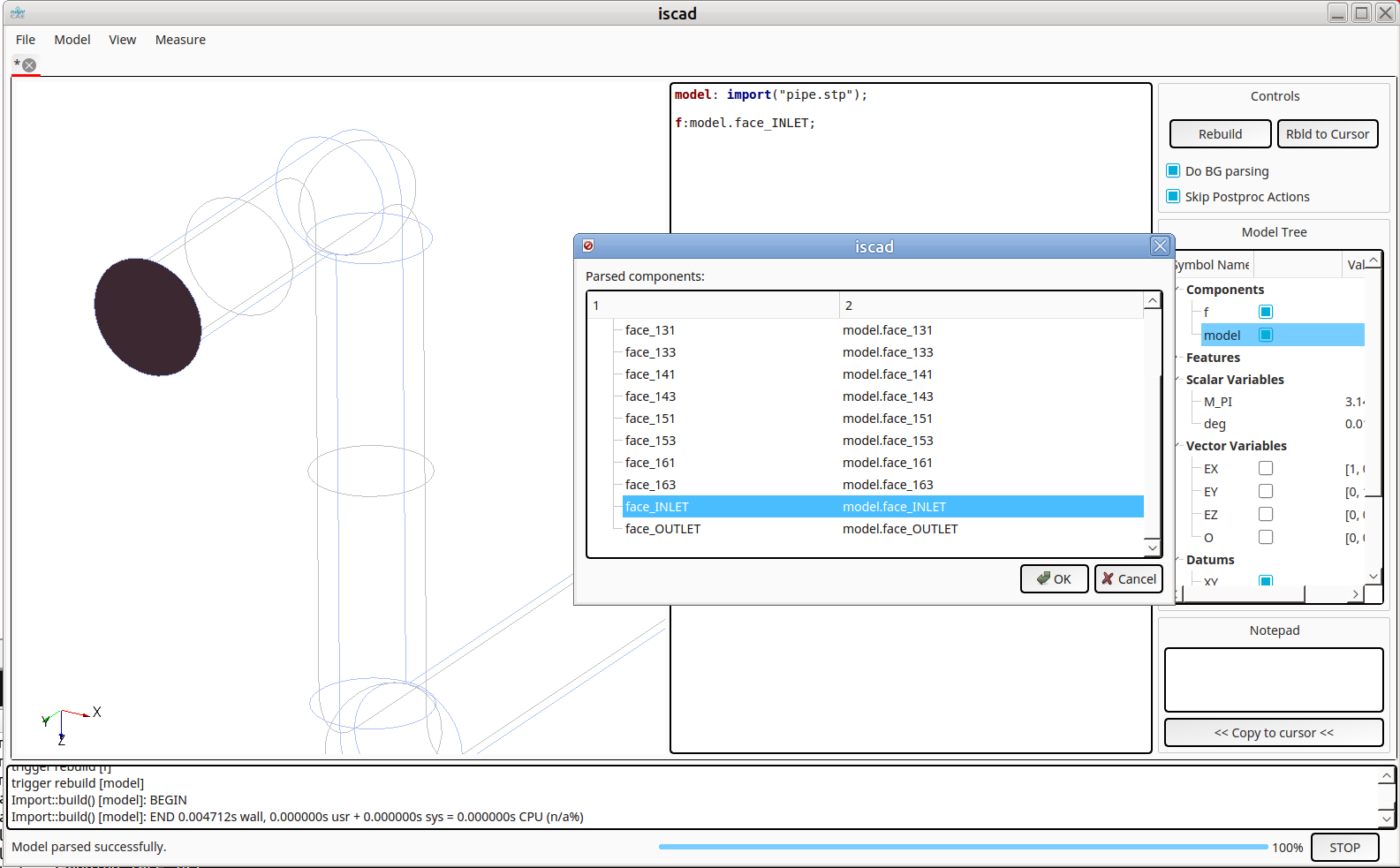
    It is now possible to access faces through their assigned names, e.g., in ISCAD. Once the STEP file is imported, its sub-entities can be explored by typing Ctrl-I (see below). The named faces appear as “face_” in the hierarchy:

    InsightCAE ISCAD import STP with named faces

  • Importing IGES File (*.IGS) from FreeShip to OpenCASCADE

    Importing IGES File (*.IGS) from FreeShip to OpenCASCADE

    FreeShip software is a convenient tool for designing hulls.
    The capabilities of FreeShip are essentially limited to the design of the fuselage exterior. For everything else, a real CAD system is required. There is an IGES export function for the transfer.
    There is also a successor: DelftShip. The IGES export function has been removed from the free version of DelftShip and is only available in the commercial version. This is not available to me, so I cannot test it.
    I would like to use the geometry in our tool ISCAD. It is based on OpenCASCADE.
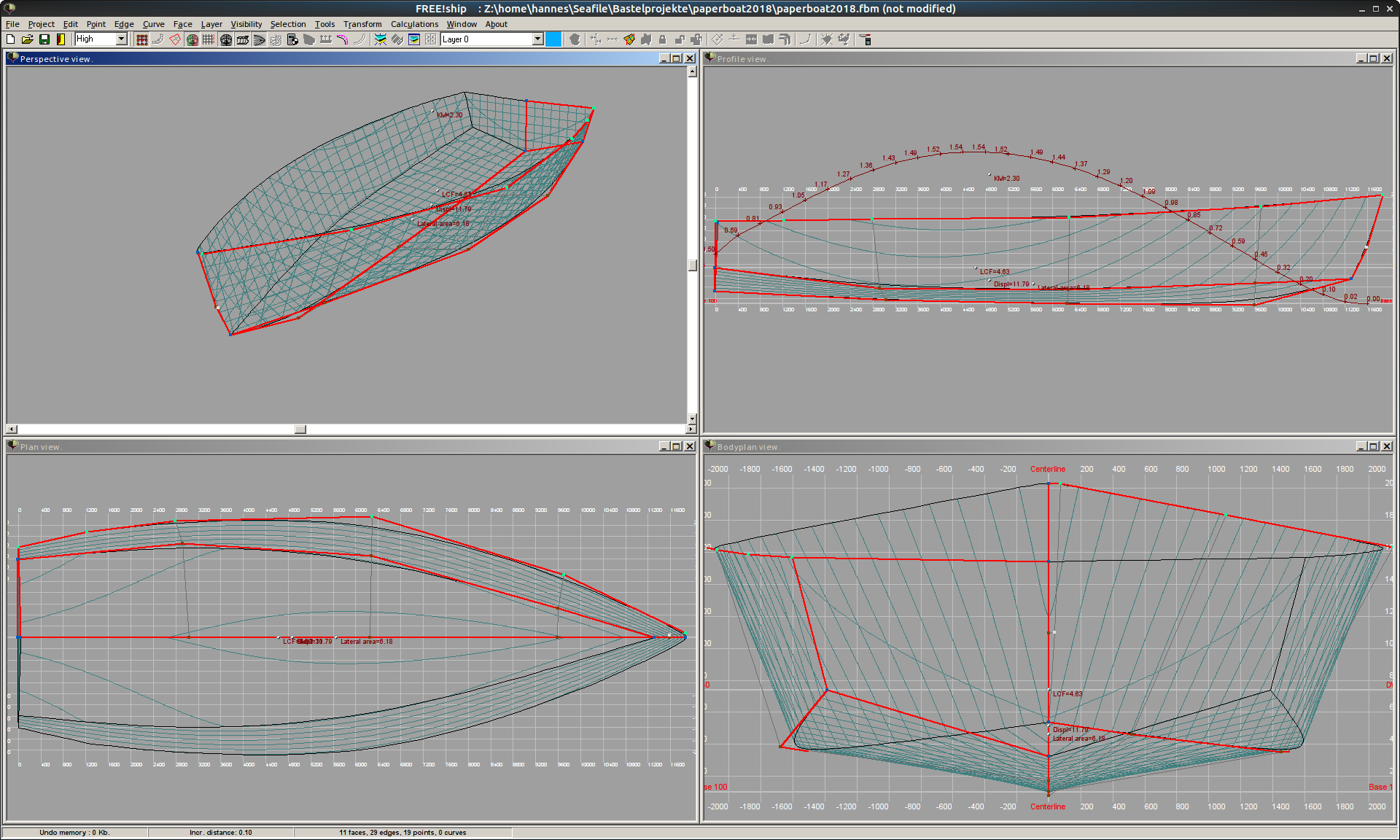
    The hull geometry modeled in FreeShip 2.6 looks like this:
    The export to an IGES file is unremarkable and creates 40 individual faces.
    The next step is the import into OpenCASCADE. However, there is a problem. OpenCASCADE (v7.2.0) reports:

    Report: 40 unknown entities.

    Total number of loaded entities: 41.

    Nothing is displayed. Although it is reported that an import works with earlier versionshttps://forum.freecadweb.org/viewtopic.php?t=1670), the import doesn't work with the current OCC version, nor with different older versions of Salome (and OpenCASCADE). On the other hand, the import works, for example, in the commercial CAD software Creo.

    Finally, a study shows that the file exported by FreeShip contains only entities of type 128 (spline surface). In addition, there is a single color definition at the beginning. At the end of the parameter block of a 128 surface (see e.g. https://wiki.eclipse.org/IGES_file_Specification#Rational_B-Spline_Surface_.28Type_128.29) are the start and end parameters (min/max U and V values) of the surface. These entries are omitted by FreeShip and for OpenCASCADE this is an error.

    One workaround is to patch the IGES import of OpenCASCADE. The corresponding code is located from line 188 in the file IGESGeom/IGESGeom_ToolBSplineSurface.cxx. I removed the error message and inserted default parameter limits:

      if (!PR.ReadReal(PR.Current(), aUmin) || !PR.ReadReal(PR.Current(), aVmin)){
        //Message_Msg Msg106("XSTEP_106");
        //PR.SendFail(Msg106);
        aUmin=0.0;
        aVmin=0.0;
      }
    
      if (!PR.ReadReal(PR.Current(), aUmax) || !PR.ReadReal(PR.Current(), aVmax)){
        //Message_Msg Msg107("XSTEP_107");
        //PR.SendFail(Msg107);
        aUmax=1.0;
        aVmax=1.0;
      }

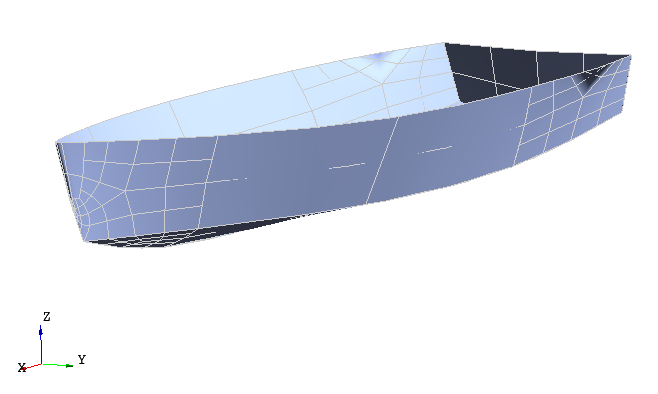
    With these modifications, the import works: