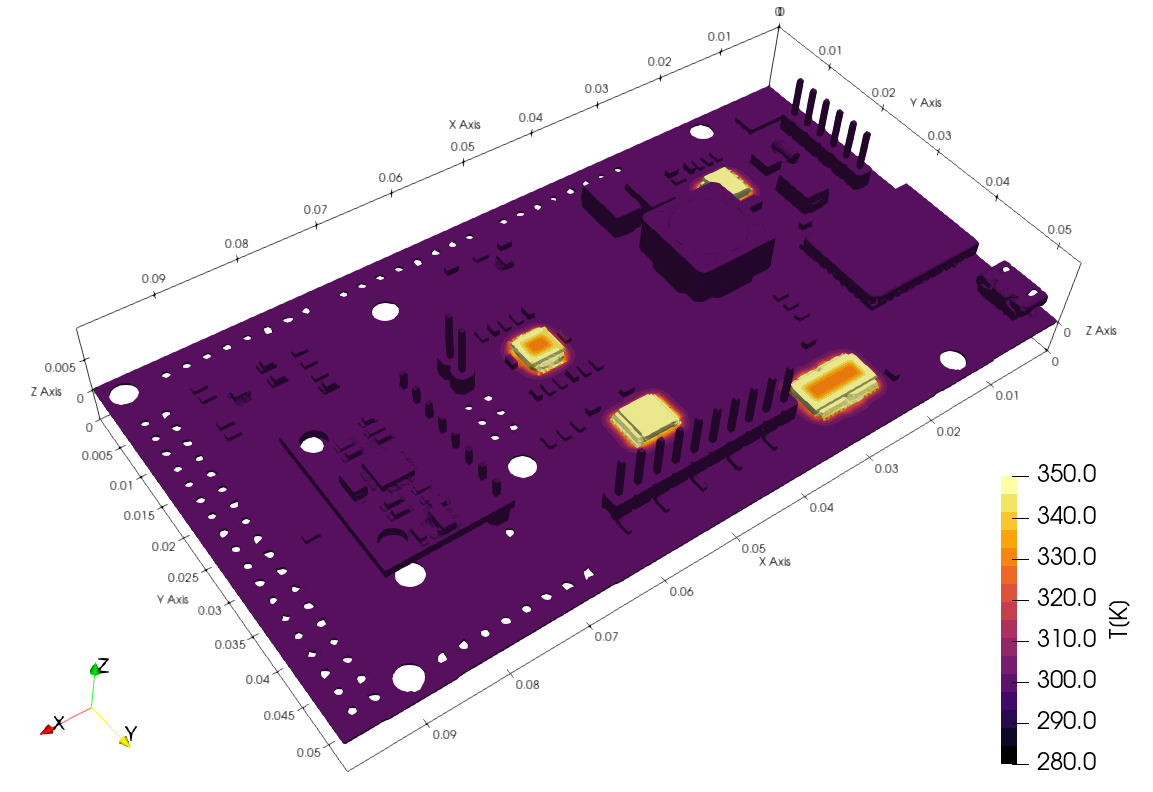
Limited space and high power consumption ultimately lead to an innovative cooling design for a wide range of PCBs. The arrangement of power supplies, the dimensions of heatsinks, and the design of the outer casing are gaining importance. Thermal simulations during the PCB design process help to avoid overheating problems in the later production phase.
Different materials, the combination of heat conduction, convection, and radiation in solids and air result in a rather complex thermal simulation. Setting material properties, boundary conditions, solver settings, and coupling areas often takes a significant amount of time.
As an example, a typical printed circuit board (PCB) with its components is presented.

Thermal simulation
Silentdynamics managed to set up the simulation using OpenFOAM thermal solvers (chtMultiRegionFoam, chtMultiRegionSimpleFoam) to bundle within the InsightCAE framework for rapid preprocessing.
The import of CAD files for each component and the optimized process of parallel meshing of the regions with snappyHexMesh are essential for the conservative thermal coupling of the different regions.
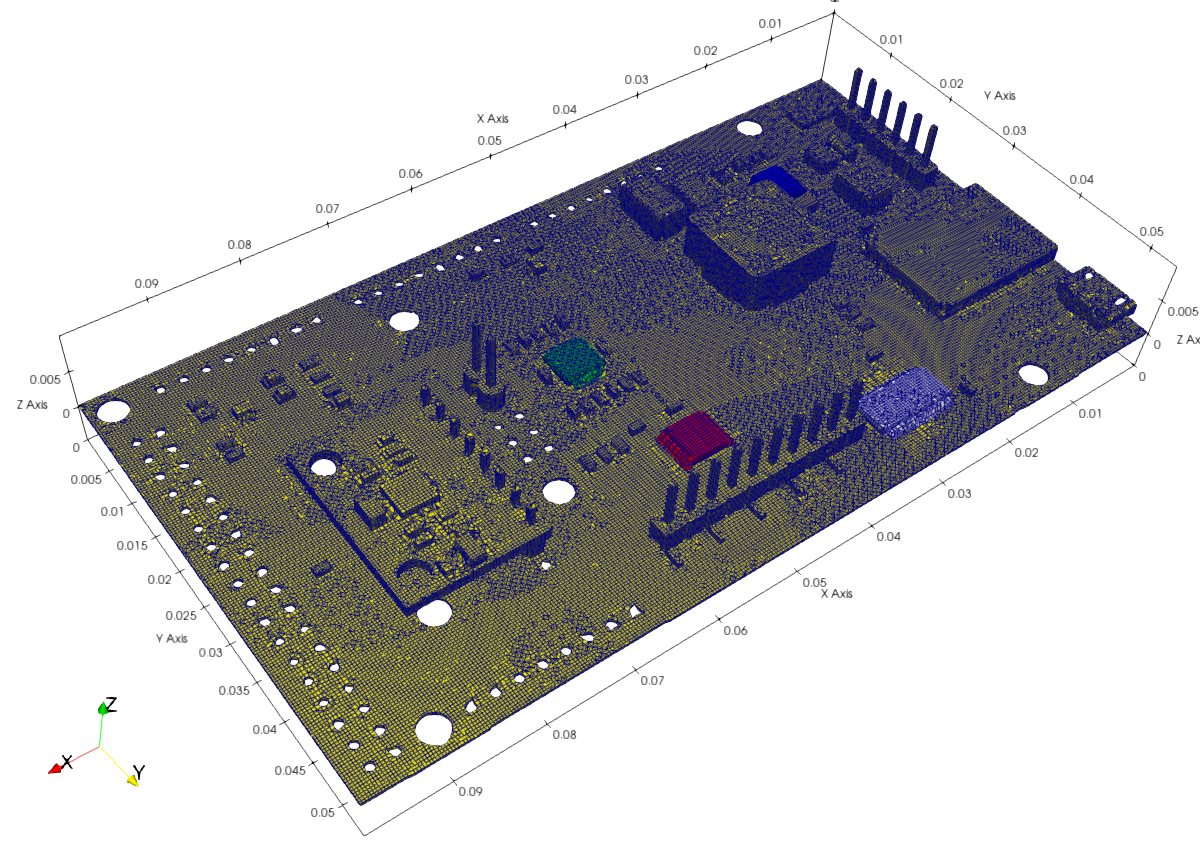
Please note that the use of different Vias, copper wires, thermal interface materials, or other heat-related points must be considered in the simulation model. With the help of region modeling, CellSets, and layer definitions for each component, all necessary thermal properties can be taken into account.
The ability to define special placeholders makes the setup of the CHT simulation nearly automated.
Furthermore, improved treatment of thermal radiation and optimized solver settings form the basis for stable and convergent simulations.