

Lack of space and high cost pressure ultimately lead to increasingly complex and smaller hydraulic tanks. This results in a drastic reduction of air separation in the tank – and thus to an increased amount of free air in the hydraulic system.
In hydraulic systems, free air remains a technical challenge today. As long as the air is dissolved in the oil, it does not alter its properties.
Unresolved air, i.e., air bubbles, cause:
Corrosion on pumps and controls
Reduced efficiency of pumps and hydraulic motors, increased compressibility and thus possible jerky movements in the drive. In addition, there is
- Accelerated oil aging
- Noise increase
- Damage to components (e.g., cavitation)
- etc.
Air enters the system during assembly, through leaks in the negative pressure area, and when oil flows back into the tank. Depending on the separation efficiency of the filter-tank system, the air rises slowly in the tank and is drawn back in by the pump.
Simulation in Air-Liquid Tanks
Silentdynamics uses InsightCAE to perform a series of simulations of dispersed gas bubbles in a degassing tank. The application of the solver twoPhaseEulerFoam enables the unsteady-state tracking of the gas phase, integral values of air at the outlets, and the overall quality of the degassing device.
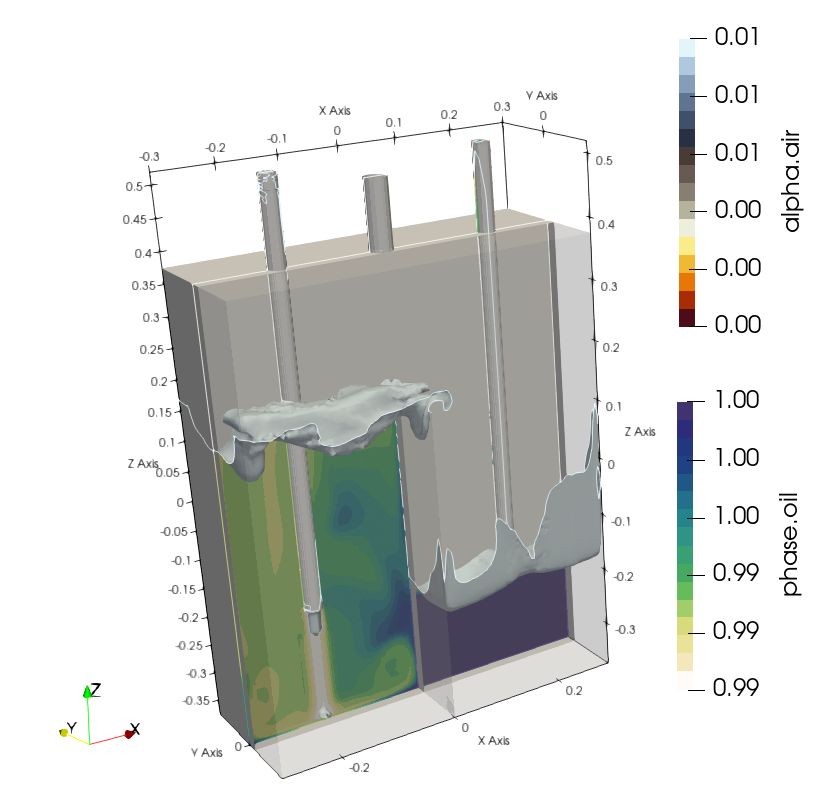
As an example, a simple degassing example is presented. One inlet and two outlets, including a wear plate in the middle. The oil-gas mixture moves over the wear plate for degassing.
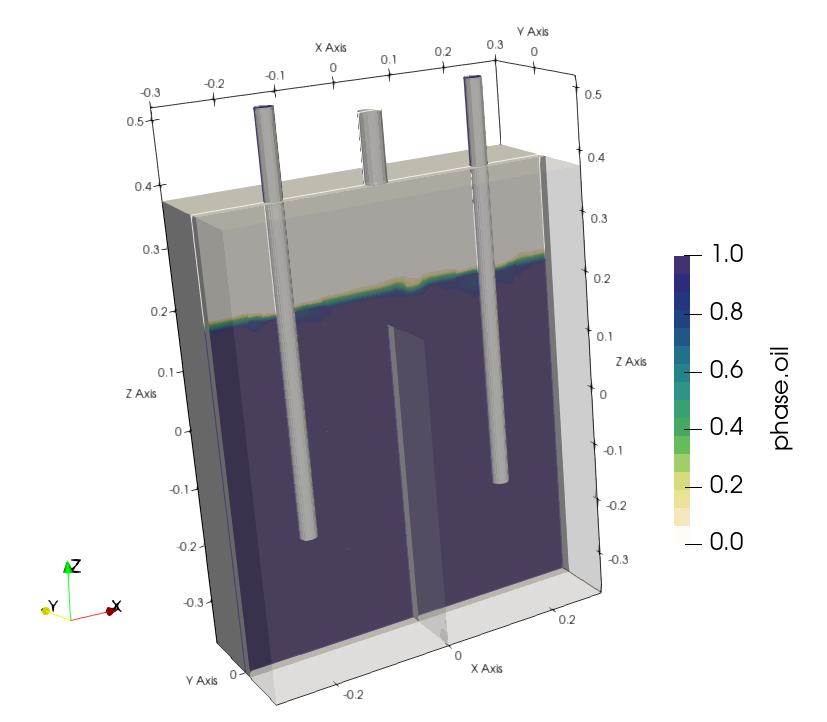
After setting the gas-oil dispersion boundary conditions such as gas bubble size, mixing coefficients, phase properties, etc., the simulation was able to proceed with twoPhaseEulerFoam to be started.
Using the advanced solver settings within InsightCAE allows for large time steps to be taken, enabling simulations to be completed in a reasonable amount of time.
Iso-surfaces of at a gas phase fraction of 1%.

The modification of the degassing tank's geometry using numerical simulation leads to a sufficient degassing process of the hydraulic oil.