

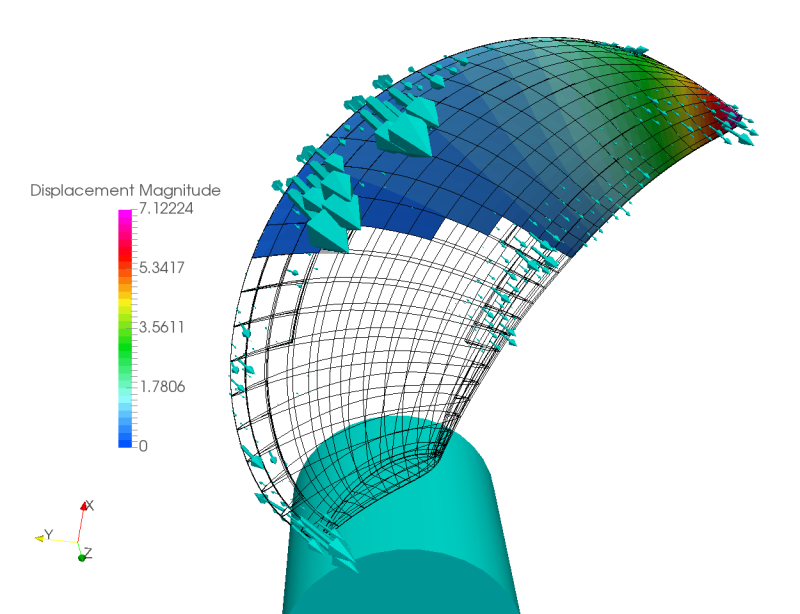
Modern fiber-reinforced composite ship and flow propellers offer significant advantages over traditional metal propellers – lower weight, improved cavitation properties, and the possibility of passive pitch adjustment through targeted anisotropy. However, their flexibility presents particular design challenges: the aerodynamic or hydrodynamic performance can only be correctly assessed if the structural deformation under operational load is included in the simulation.
Composite Propellers: Opportunities and Design Challenges
Propeller with wings made of Fiber composites – especially those made of carbon fiber-reinforced plastic (CFK) or glass fiber-reinforced plastic (GFK) – are elastically deformable under operating loads. This flexibility is not a design flaw, but can be used strategically:
- Passive pitch adjustmentThrough targeted fiber orientation, the wing twists into a more favorable airflow as the load increases – automatically, without active mechanics.
- Cavitation reductionThe adjustment of the blade geometry under load can smooth out pressure peaks, thereby reducing the risk of cavitation.
- Noise reductionReduced pressure pulsations through optimized load distribution over the blade
- Weight savingsCFK propellers are significantly lighter than bronze or stainless steel propellers of the same stiffness.
The flip side: When interpreting, you must consider Deformation of the wings under operating load must be taken into account.. A purely rigid CFD simulation would systematically mispredict the actual geometry in operation—and thus thrust, torque, and efficiency.
What is Fluid-Structure Interaction (FSI)?
The Fluid-Structure Interaction (FSI) describes the interaction between a flowing fluid and an elastic structure. In the case of a composite propeller, this means:
- The Fluid (water or air) exerts thrust on the propeller blades
- The Structure deforms elastically as a result of these forces
- The altered geometry in turn influences the Flow – and thus the pressure distribution
- This cycle will iterative until convergence solved
Depending on the stiffness of the structure and the strength of the flow forces, this coupling effect can be small and negligible—or so dominant that it fundamentally determines the design. With flexible composite propellers, the latter is usually the case.
Our Software Solution: OpenFOAM + Code_Aster Fully Coupled
We have a specialized Software solution for FSI simulation of composite propellers developed a solution that combines two leading open-source programs into a powerful, fully automated workflow:
- OpenFOAM The CFD simulation handles: calculation of the flow field, pressure distribution, and hydrodynamic forces on the propeller blade – including rotating mesh regions (MRF or Sliding Mesh).
- Code_Aster addresses the structural mechanics aspect: finite element analysis of the anisotropic composite material under the applied fluid forces, calculation of deformations and stresses in the laminate
- An Matching algorithm transfers forces and displacements between the two solvers and updates the CFD mesh in accordance with the structural deformation (dynamic mesh morphing)
Both tools are completely open-source – with no licensing costs, full transparency, and maximum adaptability to specific project requirements.
Technical Features of Our FSI Solution
- Anisotropic Material Modeling: Code_Aster models the laminate structure of CFRP and GFRP composites layer by layer—including direction-dependent stiffness and strength properties
- Cavitation modeling: Optionally, the FSI simulation can be extended to include a cavitation model in order to capture the interaction between phase change and blade deformation
- Automated workflow: The entire simulation workflow—meshing, solver setup, coupling, and post-processing—is script-driven and reproducible within the InsightCAE framework
Results and key figures from the FSI simulation
From a complete fluid-structure interaction simulation for composite propellers, you will obtain, among other things:
- Thrust and torque characteristics considering the actual operating geometry
- Displacement field (from which deflection, twist, torsion) over the entire propeller blade
- Stress and Strain Distributions in Laminates – Basis for Strength Verification according to Puck, Tsai-Wu, or Similar Criteria
- Pressure distribution on the suction and pressure sides of the wings
- Cavitation index and cavitation propagation (with extended modeling)
- Efficiency and operating point stability across the entire characteristic curve range
Areas of application
Our FSI solution for composite propellers can be used in the following areas:
- Carbon fiber or glass fiber ship propellers for high-performance and sports boats
- Underwater drones and AUV propulsion with noise emission or lightweight requirements
- Wind turbine rotor blades (small wind turbines, vertical axis systems)
- Tidal stream turbines with flexible composite blades
- Research applications for validating FSI algorithms
Conclusion: Precise propeller design through physically consistent FSI simulation
Those who design composite propellers with rigid CFD risk systematic errors in performance prediction and structural design. Our coupled simulation solution, based on OpenFOAM and Code_Aster, closes this gap – cost-efficient, transparent, and fully automated. This allows you to design composite propellers as they actually work: deformed, stressed, and performance-optimized.
Are you developing a composite propeller and need a robust FSI simulation? Contact Us We guide you from geometry to the validated result.