

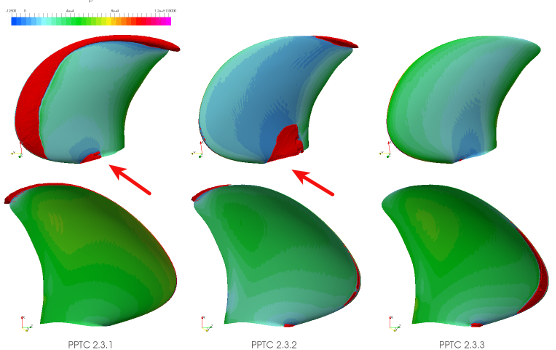
Cavitation is among the most critical and costly phenomena in fluid-flow turbomachinery. It limits the operating range, reduces efficiency, causes noise and vibrations – and in the worst case, can lead to irreversible material damage within a short period. CFD-based cavitation simulation is currently the most reliable tool for effectively addressing this phenomenon even during the design phase.
What is cavitation – and why is it so dangerous?
Cavitation describes the local evaporation of a liquid due to a pressure drop below the vapor pressure-dependent boiling point – without a temperature increase. In turbomachinery, this pressure drop typically occurs at points of high flow velocity: on the suction side of pump impellers, at the pressure edge of propeller blades, or in tight clearance areas.
The resulting vapor bubbles collapse abruptly as soon as they reach areas of higher pressure. This collapse creates:
- Micro-pulse beams with local pressure peaks of several thousand bar – primary cause of material removal (cavitation erosion)
- Pressure pulsations and vibrations, the bearings, seals, and adjacent structures are stressed
- Learning development through broadband acoustic emissions in the characteristic crackling and knocking sound
- Performance dropLarge cavitation areas block flow cross-sections and lead to a collapse in head or thrust.
Cavitation as a limiting phenomenon for turbomachinery
The Cavitation is a limiting phenomenon for turbomachinery, that operate in liquids. For predicting the onset of cavitation and its effects on machine performance, the CFD simulation as the most reliable method Einsatz. Affected are almost all machine types in which liquids are accelerated or redirected:
- Centrifugal pumps – especially at low inlet pressure (NPSH deficiency)
- Ship and underwater propellers – under high load or partial load operation
- Pump turbines and water turbines (Francis, Kaplan, Pelton) – in partial load and overload ranges
- Hydraulic Motors and Pumps in High-Pressure Systems
- Inducer Stages in Rocket Engines and High-Performance Pumps
Cavitation Simulation with CFD: Physical Fundamentals
modern CFD cavitation models are based on a Two-phase approach: The flow is modeled as a mixture of liquid and vapor phases, with the local vapor fraction governed by a transport equation. Established modeling approaches include:
- Schnerr-Sauer modelBased on the simplified Rayleigh-Plesset equation for bubble growth; well validated for pump cavitation
- Zwart-Gerber-Belamri ModelConsiders the interaction between bubble population and mass transfer; widely used in industrial applications
- Merkle ModelPressure-based mass transfer approach, particularly stable in transient computations
The cavitation model is supplemented by suitable Turbulence models (k-ω SST, k-ε Realizable) and – if necessary – by models for thermal effects that become relevant with cryogenic fluids or hot water.
What specifically does CFD cavitation simulation achieve?
A carefully set up cavitation simulation provides much more than just a statement about whether cavitation occurs. Typical results include:
- Cavitation InceptionDetermination of the critical operating point (pressure, flow rate, speed) at which cavitation begins – as a basis for NPSH curves and safety verification
- Spatial cavitation propagationVisualization of steam volume fractions over blade surfaces, in the gap, or in the suction mouth – to identify areas prone to erosion
- Performance loss due to cavitationQuantification of the head or thrust drop as a function of the cavitation index σ
- Unsteady Cavitation DynamicsSimulation of periodically collapsing cavitation structures (cloud cavitation, sheet cavitation) and their pressure pulsations
- Erosion potential mapsIdentification of material removal zones by evaluating local pressure pulses during bubble collapse
Our Workflow: Cavitation Simulation with Open-Source Software
Our cavitation simulations are fully performed with Open-source software carried out – primarily with OpenFOAM and embedded in the automated InsightCAE Workflow:
- Geometry and networkingAutomated mesh generation with fine wall resolution and mesh refinement in cavitation-prone areas
- Inpatient pre-examinationFast evaluation of the pressure field and identification of critical zones without a cavitation model
- Unsteady Cavitation SimulationActivation of the two-phase model and calculation of time-dependent cavitation behavior
- Automated Post-ProcessingCharacteristic curve evaluation, Visualization of vapor volume fractions, Pressure pulsation analysis
- Parameter variationSystematic calculation of multiple operating points for generating complete NPSH curves
Cavitation simulation as a basis for cavitation-resistant design
The true strength of CFD-based cavitation analysis lies not just in diagnosis—but in Optimization. Based on the simulation results, specific design measures can be identified and evaluated:
- Adjustment of blade geometry (profile shape, leading edge, curvature) to optimize pressure distribution
- Variation of the inlet pressure and the impeller front recess
- Use of cavitation-resistant materials in identified erosion zones
- Geometric Optimization of Inducer Stages for NPSH Reduction
In combination with our automated optimization framework, many geometry variants can be systematically investigated for their cavitation behavior – without additional manual effort for each variant.
Conclusion: Calculate cavitation before it causes damage
Cavitation in turbomachinery is not an uncontrollable fate—it is predictable, localizable, and can be controlled through targeted design measures. CFD cavitation simulation based on OpenFOAM offers the most accurate and cost-effective tool for this purpose: it requires no license fees, is fully automatable, and can be integrated directly into the design process.
Do you want to numerically investigate the cavitation behavior of your pump, propeller, or turbine? Contact Us – We analyze your machine and identify optimization potential before damage occurs.