

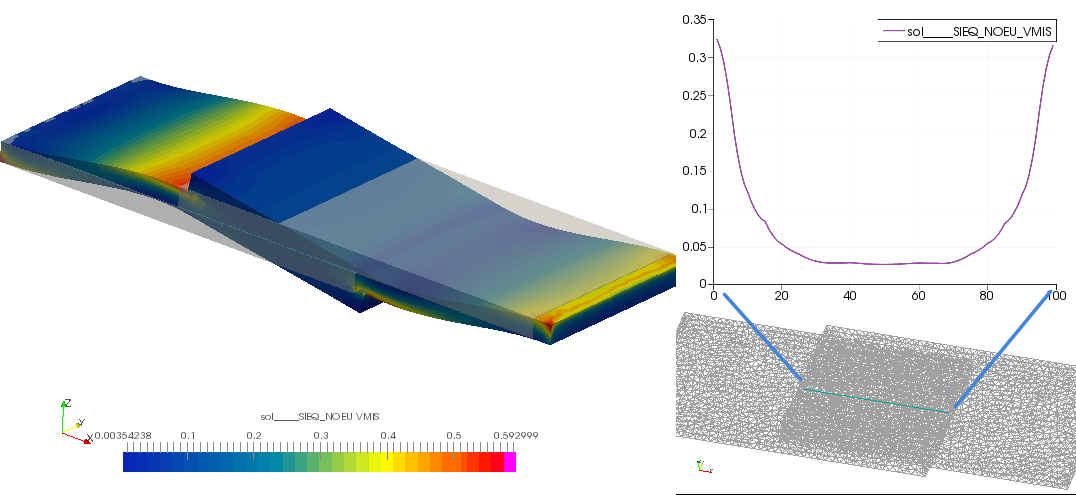
Adhesive bonding is playing an increasingly important role in modern constructions – from aerospace and automotive engineering to wind turbines and general mechanical engineering. In contrast to form-fitting connections such as screws or rivets, adhesive bonds transmit loads over an area, reduce notch effects, and enable the joining of diverse materials. This makes reliable computational assessment all the more important – especially with the Finite Element Method (FEM).
FE Modeling of Adhesive Joints
Similar to bolted connections, adhesive bonds can also be precisely considered in FEM models. We use a modeling technique that not only correctly maps global load transfer but also enables a sufficiently detailed assessment of stresses within the adhesive layer itself. This reliably identifies and evaluates critical areas such as adhesive layer edges, overlap zones, and peel stress peaks.
Why is correct FEM modeling of adhesive layers crucial?
The adhesive layer is the mechanically critical element of the bond, despite its often small thickness. Simplified or neglected modeling frequently leads to:
- Underestimation of peeling stresses at the edges of the overlap – one of the most common failure mechanisms for adhesive bonds
- Faulty stiffness mapping of the overall system, especially with hybrid constructions made of metal and fiber composite materials
- Inadequate assessment of fatigue loads, which can lead to creeping failure of the interface under cyclic loading
- Overlooking residual stresses from the curing process, which significantly affects the effective load-bearing capacity
Our modeling strategy in detail
Depending on the requirements and available computing power, we use different, coordinated modeling approaches:
- Volume elements for the adhesive layer enable direct, three-dimensional stress evaluation within the adhesive, particularly for normal and shear stress components
- Cohesive Zone Models (CZM) represent the progressive failure of the interface and are suitable for fracture mechanics and delamination analyses
- Tie-constraints and surface-to-surface contacts – for efficient modeling in system simulations with many joining partners
- Material Models for Adhesives – from linear-elastic through viscoelastic to elastoplastic, adapted to the respective adhesive type (epoxy resin, polyurethane, acrylate, etc.)
Evaluation criteria and proof of failure
Based on the FEM results, we perform a structural mechanics assessment according to recognized codes and internal methods:
- Stress-based detection of shear, peel, and normal stresses in the adhesive layer
- Comparison with adhesive properties from data sheets or own tests (e.g., tensile shear test according to DIN EN 1465)
- Safety evidence against cohesive and adhesive failure
- Consideration of temperature influences on adhesive properties (glass transition temperature, thermal expansion)
Typical application areas
Our FEM-based adhesive joint analysis is used in many industries and components:
- Structural Adhesions in Lightweight Construction – Aluminum-CFRP Hybrid Joints, Sandwich Structures
- Wind turbines – Rotor blade bonding and flange connections
- Automotive engineering – body stiffeners, windshield bonding, battery enclosures
- Mechanical and apparatus engineering – Adhesive bonding for bearings and seals under mechanical and thermal loads
- Electronics and Medical Technology – Miniaturized Adhesive Bonds with High Reliability Requirements
Simulate adhesive bond now
Do you want to computationally verify the load-bearing capacity of an adhesive bond or expand an existing FEM model with a realistic adhesive layer modeling? Contact us.