

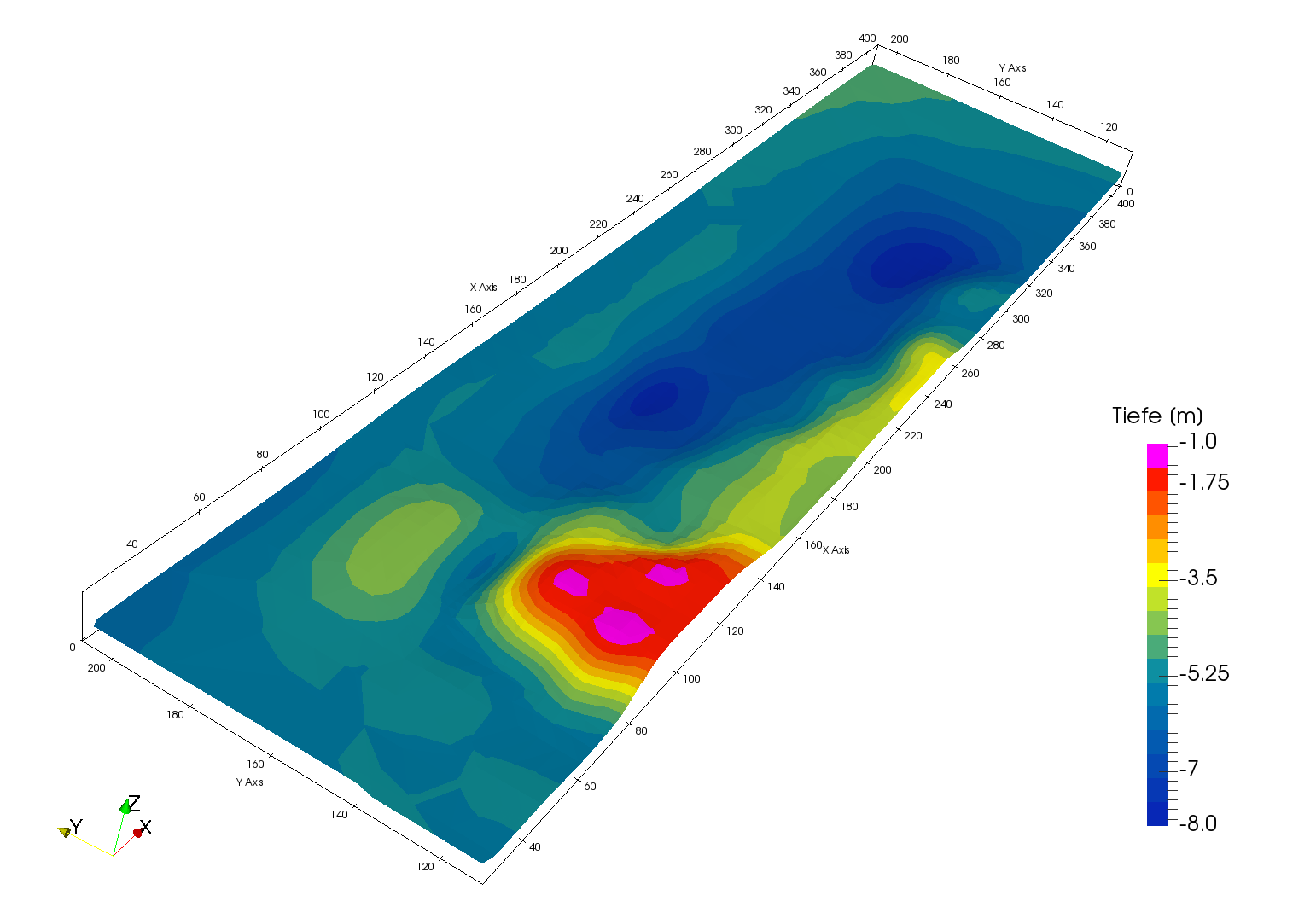
As part of an innovative energy concept, a harbor basin is being used as a natural heat source and sink for the cooling and heating operations of surrounding office buildings. Surface waters such as harbor basins, lakes, or rivers are ideally suited as the basis for water-based heat pump systems due to their thermal storage capacity and can achieve significant energy savings compared to conventional air conditioning systems.
Thermal simulations were carried out to assess the thermal impacts on the water body, quantifying the temperature influence of heat withdrawal and heat input on the harbor basin. Such simulations are essential to ensure that the water temperature remains within ecologically and legally permissible limits and that no undesired thermal stratification occurs.
Particular attention was paid to the hydraulic design of the supply and discharge lines at the quay wall. Thermal or hydraulic short circuits—that is, the direct return of already tempered water to the intake point—would significantly reduce the efficiency of the system. Through careful positioning and flow engineering of the inlet and outlet structures, this effect can be reliably prevented.
To avoid excessively high flow velocities in the harbor basin, the number of inlets and outlets was varied and optimized. High local flow velocities can cause sediment resuspension, negatively impact aquatic life, and lead to increased wear on technical equipment. Distributing the volumetric flow rate across multiple discharge points reduces these risks and ensures more uniform flow through the basin.
The intake boxes were specifically sized to prevent the entry of fish and other aquatic organisms into the pipeline system. In practice, fine-mesh grates, screens, or special protective grids are used, with flow velocities kept so low that fish are not sucked in. Corresponding limit values for inflow velocity are enshrined in water law regulations and environmental requirements.
Finally, the biological compatibility of the entire system was investigated. Possible impacts on the harbor basin ecosystem were assessed, particularly with regard to temperature changes, altered oxygen levels, and the introduction of non-native organisms. Environmentally compatible planning ensures that the operation of the facility is in accordance with water law approval requirements and the objectives of the European Water Framework Directive.