

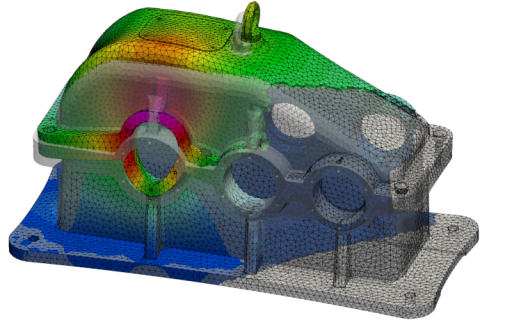
Code_Aster is one of the most powerful yet demanding open-source finite element codes worldwide, developed and continuously maintained by the French energy company EDF. With a feature set that surpasses many commercial FEM programs, Code_Aster is particularly well-suited for complex structural, thermal, and coupled analyses in industrial and scientific environments.
We have more than 10 years of practical experience in the professional use of Code_Aster and use this FEM code for a wide spectrum of demanding calculation tasks – from simple static analysis to highly complex transient simulations with nonlinear material behavior and contact.
Our services with Code_Aster at a glance
Static and transient structural analyses
Whether it's operating load, impact, or time-varying loads – we calculate the mechanical behavior of components and structures under realistic load conditions. We utilize the full range of element types offered by Code_Aster:
- Volume elements – for massive components, welds, and complex 3D geometries with detailed stress analysis
- Shell elements – for thin-walled structures like sheet metal, containers, pipelines, and housings with high computational efficiency
- Stab and beam elements – for frame structures, steel structures, and system models with many degrees of freedom
Contact problems and nonlinear analyses
Contact problems are among the numerically most challenging tasks in FEM. Code_Aster offers robust algorithms for this purpose, which we specifically employ for issues such as press fits, bonded joints, sealing surfaces, or the lifting of components under operational loads. Geometric and physical nonlinearities – such as large deformations or elastoplastic material behavior – are also accurately represented.
Screwed connections
The realistic modeling of bolted connections in FEM models requires both methodological know-how and experience with the peculiarities of the respective solver. We simulate pretension forces and the elastic behavior of bolted connections using proven methods – for reliable validations according to common standards such as VDI 2230.
Eigenfrequency analysis and modal analysis
Knowledge of the natural frequencies and mode shapes of a structure is a prerequisite for assessing resonance risks and designing vibration-damped constructions. With Code_Aster, we perform modal analyses and, if necessary, combine them with harmonic or transient vibration response calculations – for example, for rotating machinery, piping systems, or seismically stressed installations.
Why Code_Aster – and why with us?
- No licensing cost overhead Code_Aster is open source under the GPL license and enables cost-effective calculations even with high computational volumes or parallel projects.
- High solver quality The code has been used and validated by EDF for safety-critical applications in nuclear engineering and power supply for over 30 years.
- Reproducible, documented results – all simulations are built in a traceable manner and completed with engineering evaluation of the results
Typical Industries and Application Areas
Our Code_Aster projects span numerous industrial and engineering fields:
- Mechanical and plant engineering – stress analysis for pressure vessels, flanges, welded constructions
- Energy and Process Engineering – Piping Analyses, Heat Exchangers, Vessel Design
- Vehicle and Rail Vehicle Technology – Crash-Relevant Structures, Durability Proofs
- Aerospace – Lightweight structures with fiber composite materials and adhesive bonding
- Construction and Infrastructure – Seismic Analysis, Steel Construction, Foundation Verification
Requesting FEM calculation with Code_Aster
Are you looking for an experienced partner for structural mechanics calculations with Code_Aster? Contact us – we will discuss your task and jointly develop an efficient and robust simulation strategy.