

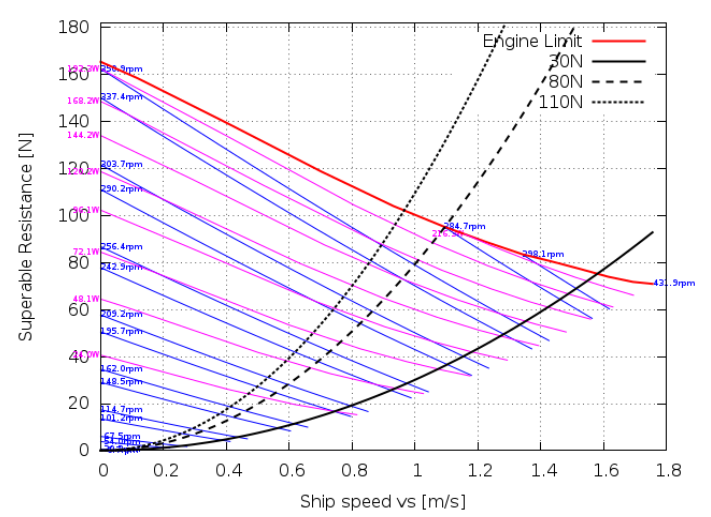
After determining a propeller open-water curve with CFD (Computational Fluid Dynamics) or another calculation method, a further analysis – especially a Propulsion Analysis – required to reliably predict the propulsion performance for a specific ship. We have developed specialized analysis software solutions that enable seamless integration into the ship design process, relying exclusively on open-source software.
From the Drift Curve to the Propulsion Analysis
The Propeller free-running curve (also called the open-water curve) describes the hydrodynamic behavior of a propeller under defined conditions—without the influence of the ship's hull. It provides fundamental performance metrics such as the thrust coefficient (KT), torque coefficient (KQ) and propeller efficiency $(\eta)$ as a function of the advance coefficient $(J)$.
This curve forms the basis for all further analyses, but by itself is not sufficient to represent the actual Propulsion power in real ship operation to be determined. Only a complete propulsion analysis – taking into account hull resistance, wake, suction, and mechanical losses – can provide a reliable performance prediction.
Drive analysis: Methodology and calculation steps
A complete Ship propulsion analysis typically includes the following steps:
- Resistance prediction: Determination of the total resistance of the ship at a given speed, e.g., by CFD simulation or based on recognized approximation methods (ITTC methods, Holtrop-Mennen).
- Propeller-Hull Interaction Consideration of discharge coefficient (w), suction coefficient (t), and relative rotational efficiency (η)R).
- Operating point determination Determination of the operating point of the propeller and engine in interaction (Self-Propulsion Point).
- Performance Forecast Calculation of required shaft power, including gearbox and bearing losses.
- Sea-going and fouling surcharges: Addition of practice-relevant surcharges for operation under real conditions (Sea Margin, Fouling Allowance).
Our open-source-based software solutions
We have customized Analysis software solutions developed, based exclusively on open-source technologies – transparent, flexible, and cost-efficient. Our tools are designed to integrate seamlessly into existing design processes, whether in the early conceptual stage or during the detailed design phase.
The advantages of our open-source approach:
- Transparency and traceability: All calculation steps are openly viewable and scientifically verifiable.
- Independence from commercial licensing models: No hidden costs, no vendor lock-in.
- Interoperability Easy integration with common CFD packages (e.g., OpenFOAM) and other design tools.
- Customizability Full customization to project-specific requirements and ship types.
- Community and Further Development: Benefit from an active open-source community and continuous improvements.
Areas of application and ship types
Our analysis methods are suitable for a wide range of vessel types and application areas, including:
- Merchant ships (container ships, tankers, bulk carriers)
- Workboats and offshore supply vessels
- Ferries and passenger ships
- Research and Special Vehicles
- Sports boats and yachts
Conclusion: Efficient performance prediction in modern ship design
The combination of precise CFD-based propeller analysis and a structured drive analysis forms today's State of the art in hydrodynamic ship design. With our open-source software solutions, we offer naval architects and design offices a powerful, transparent, and cost-effective tool – from the free-running curve to the final performance prediction.
Contact us to learn more about our analysis methods and software solutions, or view our case studies and reference projects.