

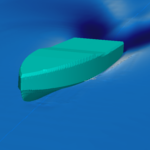
VOF Simulation of High-Speed Planing Hulls: Challenges and Solutions
Computational Fluid Dynamics (CFD) simulations of high-speed watercraft, particularly planing boats and yachts, present significant challenges even for experienced engineering firms. The widely used Volume-of-Fluid (VOF) method, in particular, exhibits specific numerical weaknesses at high Froude numbers and planing speeds, which can lead to unreliable or even unusable simulation results without targeted countermeasures.
We have developed specialized methods to overcome these challenges—delivering reliable VOF simulation results for high-speed planing boats in a short time and at competitive costs.
What is the VOF method and why is it used?
The Volume-of-Fluid (VOF) method is one of the most widely used techniques for simulating multiphase flows in maritime simulation. It models the interface between water and air by tracking a volume fraction in each computational grid cell. For the investigation of wave generation, trim angle, resistance, and dynamic ship motions, the VOF method is the standard tool in modern maritime CFD.
Typical numerical problems with high-speed hydrofoil crafts
During the transition from displacement to planing mode—starting from Froude numbers of approximately Fr > 0.5—characteristic problems arise in the VOF method:
- Numerical diffusion on the water surface that distorts the wave structure
- Instabilities due to strong pressure gradients on the fuselage bottom and at the spray line
- Convergence problems with large dynamic trim angles
- An excessively fine grid is needed to correctly resolve spray formation and wave troughs.
- Time step restrictions due to Courant conditions in the interface region
- Problematic coupling between sea state model and hull motion at high speeds
These problems affect both open-source solvers like OpenFOAM and commercial packages like STAR-CCM+ and FINE/Marine.
Our approaches for reliable CFD results
Based on extensive project experience with racing boats, high-speed ferries, military patrol boats, and sport motor yachts, we have developed a proven methodological framework:
- Adapted grid strategies (adaptive refinement, overset mesh) for the free surface region
- Robust time-stepping control combined with implicit VOF advection schemes
- Specially calibrated turbulence models (k-ω SST, modified wall treatment) for sliding conditions
- Validated boundary conditions for inflow, wave absorption, and dynamic hull motion
- Efficient parallelization to reduce computation time to practical turnaround times
What we can calculate
Our VOF simulations for high-speed marine craft typically include the following parameters and questions:
- Total resistance and its components (friction drag, pressure drag, spray resistance)
- Dynamic trim angle and squat as a function of speed and load
- Pressure distribution on the underwater hull and spray pattern
- Comparison of hull variants within preliminary design optimization
- Seakeeping and Accelerations in Wave Encounter
- Propeller-Hull Interaction and Wake Wave Profile
Areas of application
Our expertise in planing boat CFD is relevant for developers and operators of RIBs, fast boats (offshore patrol vessels), racing catamarans, seaplane floats, and planing hull sports and leisure boats.
Frequently Asked Questions (FAQ)
How long does a typical planing boat CFD simulation take?
Depending on the complexity of the hull and the required accuracy, typical computation times range from a few hours to several days on modern HPC systems. Through our optimized meshing and solver settings, we significantly reduce the time to result compared to standard workflows.
Can VOF also be used for hull optimization?
Yes. VOF simulations are well-suited for parametric studies where multiple hull variations are systematically compared. The relative ranking of designs is typically very reliable, even if the absolute drag values require validation data.
What software is being used?
We exclusively rely on OpenFOAM — the powerful open-source CFD solver widely used in maritime research and industry. This gives us full control over meshing, solver settings, and postprocessing, without any license costs that would need to be passed on to the customer.