Category: Hydrodynamics

  • Virtueller Schleppkanal – Schiffswiderstand digital berechnen

    Virtual Towing Tank - Calculate Ship Resistance Digitally

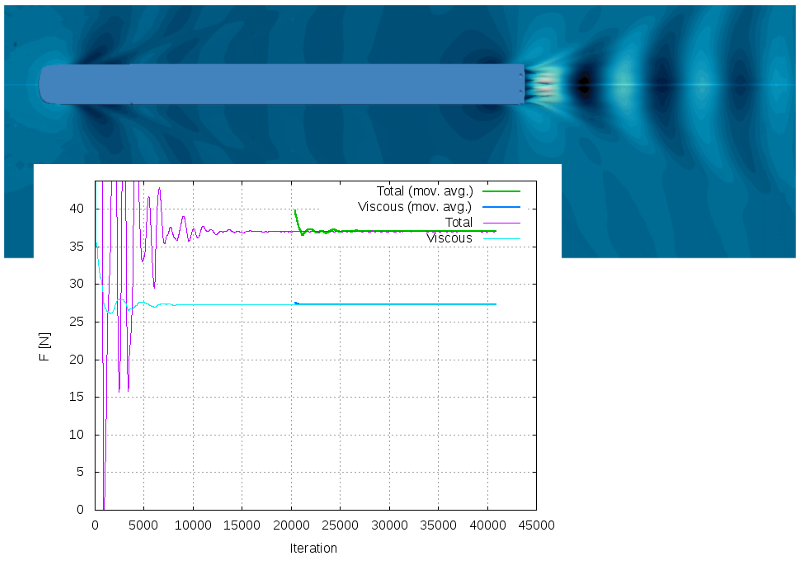
    Traditional towing tests in physical model basins are costly and time-consuming. Our virtual towing tank based on InsightCAE and OpenFOAM enables precise ship resistance simulations – faster, more cost-effective, and fully reproducible. And the best part: you don't have to deal with the simulation software yourself – we can perform the simulations entirely on your behalf if desired.


    What is a virtual wind tunnel?

    A towing tank is traditionally a long water basin where a scaled ship model is physically pulled through the water to measure drag and propulsion forces. The virtual towing tank transfers this principle to computational fluid dynamics (CFD): the ship is calculated in a computer simulation at defined speeds – without complex model construction and without waiting times due to basin occupancy.

    The basis of our simulations is OpenFOAM, the leading open-source CFD platform, combined with the InsightCAE framework, which makes the entire simulation workflow – from mesh generation to the solver to evaluation – automated and reproducible.

    InsightCAE: Efficiency Through Automation

    InsightCAE is an open-source tool for automating and managing OpenFOAM simulations. It standardizes mesh generation, boundary conditions, and evaluation, allowing for parameter studies with minimal manual effort. We pass the benefits of this powerful infrastructure directly to you – you receive professional CFD results without having to learn the software yourself.


    Scope of services

    • Resistance Calculation Friction and pressure resistance, wave pattern, and trim based on RANS equations.
    • Parameter Studies Systematic comparison of hull variants, drafts, and speed ranges.
    • Resistance curve: Calculation on the relevant Froude number range for design and operational optimization.
    • Evaluation & Report: Structured result reports with pressure distributions, flow visualizations, and comparative key figures.

    Advantages over the physical model experiment

    Virtual towing tests reduce lead times from weeks to days. Geometric variations can be adjusted directly in the simulation without new model construction. At the same time, space costs for model basins as well as travel and logistics expenses are eliminated. The numerical method clearly has the advantage, especially in early design phases where many hull alternatives need to be evaluated.

    Our simulations are guided by the recommendations of the ITTC (International Towing Tank Conference) for CFD validation and mesh convergence to provide reliable, engineering-usable results.


    This is how an order works

    1. Pass Geometry – You provide us with the hull geometry of your ship, ideally as an IGES, STEP, or STL file. If no post-processing is necessary, we can even offer an additional discount.
    2. Define boundary conditions – We coordinate depth, speed range, and other operating parameters with you.
    3. Perform simulation – Our automated InsightCAE workflow calculates drag and optional parameter variations.
    4. Get results – You will receive a structured report with key figures, visualizations, and recommendations – analyzable without simulation knowledge and digitally integrable into subsequent analysis processes.

    Costs and price list

    We pass on the cost advantage of open-source infrastructure directly to you. All prices can be found in our price list.
  • Seegangsverhalten: Methoden, Tools und Kennwerte

    Behavior in the Open Sea: Methods, Tools, and Key Performance Indicators

    The Seaway Calculation is a central element of ship design and forms the basis for assessing the behavior of ships and floating structures in real sea conditions. It provides crucial information for safety assessment and operational planning.

    What is seaway analysis and why is it important?

    Seakeeping refers to the dynamic forces generated by wind, waves, and currents to which a ship is exposed at sea. A well-founded seakeeping analysis allows for precise prediction of a ship's motion behavior as early as the design phase – before the keel is laid. This minimizes costly post-construction corrections and increases onboard safety.

    Potential codes as the basis for seaway calculation

    The analysis of wave calculations is usually done using Potential Codes performed. This method is based on potential flow theory and allows for a fast, numerically stable calculation of the hydrodynamic forces acting on a ship hull. Potential codes assume an incompressible, inviscid, and irrotational flow – assumptions that are well justified for seakeeping calculations in many practical cases.

    Response Amplitude Operators (RAOs): The Heart of Motion Analysis

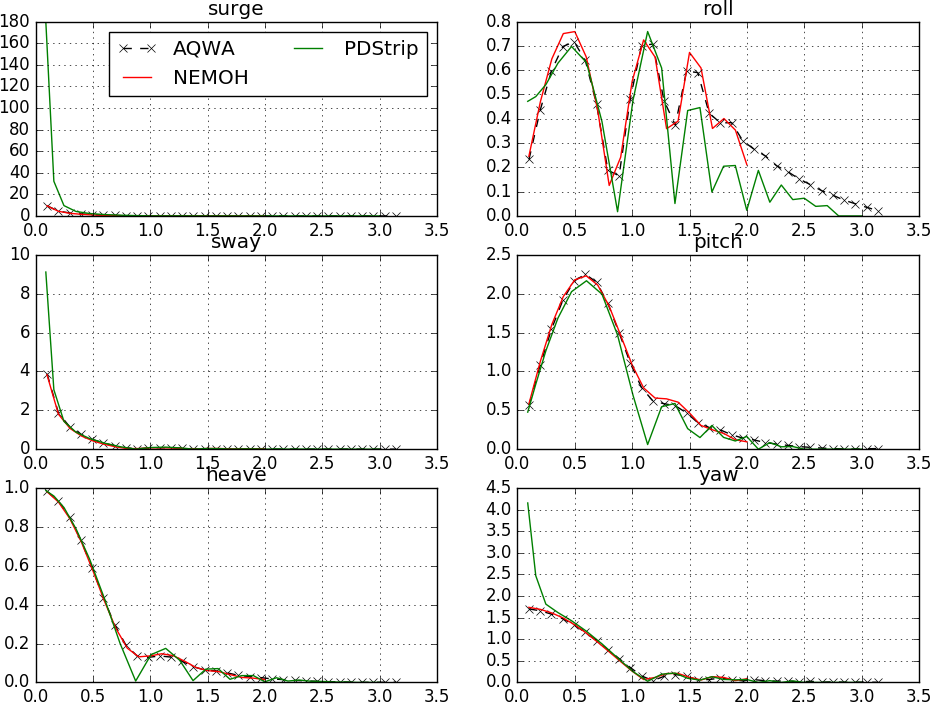
    The core of wave state calculation is determining the Response Amplitude Operators (RAOs) – also called transfer functions – for all six degrees of freedom of the ship:

    • Surge Longitudinal movement
    • Sway Wobble movement
    • Heave – Hub movement
    • Roll Rolling motion
    • Pitch Tamping motion
    • Yaw – Gear movement

    RAOs describe how strongly a ship reacts to a wave of a specific frequency and direction. They are frequency-dependent and are determined for different ship speeds and wave heading angles.

    Derived parameters: Accelerations, velocities, and seasickness criteria

    From these RAOs, a variety of practice-relevant characteristic values are subsequently calculated at arbitrary locations on the ship:

    • Accelerations (e.g., at workplaces, crane locations, or load securing points)
    • Speeds ship motion in various sea state scenarios
    • Frequency criteria for seasickness Motion Sickness Incidence, MSI
    • Relative Movements and Freeboard for evaluating green water events
    • Operability indices for safe use under specific sea state conditions

    These results directly feed into ship design, equipment layout, and the planning of offshore operations.

    Simulation with Open-Source Tools: PDStrip and NEMOH

    The simulations are being conducted with the proven Open-Source Tools PDStrip or NEMOH performed

    • PDStrip is a 2D strip theory code that is particularly well-suited for slender ship hulls and is characterized by high computational speed. It is ideal for initial design iterations and parametric studies.
    • NEMOH is a 3D potential flow panel code based on the Boundary Element Method (BEM). It is particularly well-suited for complex geometries, floating offshore structures, and cases where 3D effects cannot be neglected.

    Both tools are established in the scientific and engineering communities and benefit from active further development by research institutions worldwide.

    Seamless integration into ship resistance analysis

    A key advantage of our approach: the required input for wave calculation is fully compatible with the input for our ship resistance analysis. This means that geometry data and vessel parameters, once processed, can be directly used for both analysis types. This significantly reduces effort and ensures a consistent data foundation throughout the entire design process.

    Conclusion: Professional sea state calculation for safer and more efficient ships

    Precise seakeeping analysis is essential for modern ship design. Using potential flow codes, RAO-based motion analysis, and powerful open-source tools like PDStrip and NEMOH, well-founded statements about a ship's seakeeping behavior can be made early in the design process. The close integration with resistance analysis makes our workflow particularly efficient.

    Do you have questions about wave load calculation for your project? Contact Us – we are happy to advise you.

  • Hochgeschwindigkeits-Gleitboote

    High Speed Planing Craft

    VOF Simulation of High-Speed Planing Hulls: Challenges and Solutions

    Computational Fluid Dynamics (CFD) simulations of high-speed watercraft, particularly planing boats and yachts, present significant challenges even for experienced engineering firms. The widely used Volume-of-Fluid (VOF) method, in particular, exhibits specific numerical weaknesses at high Froude numbers and planing speeds, which can lead to unreliable or even unusable simulation results without targeted countermeasures.

    We have developed specialized methods to overcome these challenges—delivering reliable VOF simulation results for high-speed planing boats in a short time and at competitive costs.

    What is the VOF method and why is it used?

    The Volume-of-Fluid (VOF) method is one of the most widely used techniques for simulating multiphase flows in maritime simulation. It models the interface between water and air by tracking a volume fraction in each computational grid cell. For the investigation of wave generation, trim angle, resistance, and dynamic ship motions, the VOF method is the standard tool in modern maritime CFD.

    Typical numerical problems with high-speed hydrofoil crafts

    During the transition from displacement to planing mode—starting from Froude numbers of approximately Fr > 0.5—characteristic problems arise in the VOF method:

    • Numerical diffusion on the water surface that distorts the wave structure
    • Instabilities due to strong pressure gradients on the fuselage bottom and at the spray line
    • Convergence problems with large dynamic trim angles
    • An excessively fine grid is needed to correctly resolve spray formation and wave troughs.
    • Time step restrictions due to Courant conditions in the interface region
    • Problematic coupling between sea state model and hull motion at high speeds

    These problems affect both open-source solvers like OpenFOAM and commercial packages like STAR-CCM+ and FINE/Marine.

    Our approaches for reliable CFD results

    Based on extensive project experience with racing boats, high-speed ferries, military patrol boats, and sport motor yachts, we have developed a proven methodological framework:

    • Adapted grid strategies (adaptive refinement, overset mesh) for the free surface region
    • Robust time-stepping control combined with implicit VOF advection schemes
    • Specially calibrated turbulence models (k-ω SST, modified wall treatment) for sliding conditions
    • Validated boundary conditions for inflow, wave absorption, and dynamic hull motion
    • Efficient parallelization to reduce computation time to practical turnaround times

    What we can calculate

    Our VOF simulations for high-speed marine craft typically include the following parameters and questions:

    • Total resistance and its components (friction drag, pressure drag, spray resistance)
    • Dynamic trim angle and squat as a function of speed and load
    • Pressure distribution on the underwater hull and spray pattern
    • Comparison of hull variants within preliminary design optimization
    • Seakeeping and Accelerations in Wave Encounter
    • Propeller-Hull Interaction and Wake Wave Profile

    Areas of application

    Our expertise in planing boat CFD is relevant for developers and operators of RIBs, fast boats (offshore patrol vessels), racing catamarans, seaplane floats, and planing hull sports and leisure boats.

    Frequently Asked Questions (FAQ)

    How long does a typical planing boat CFD simulation take?

    Depending on the complexity of the hull and the required accuracy, typical computation times range from a few hours to several days on modern HPC systems. Through our optimized meshing and solver settings, we significantly reduce the time to result compared to standard workflows.

    Can VOF also be used for hull optimization?

    Yes. VOF simulations are well-suited for parametric studies where multiple hull variations are systematically compared. The relative ranking of designs is typically very reliable, even if the absolute drag values require validation data.

    What software is being used?

    We exclusively rely on OpenFOAM — the powerful open-source CFD solver widely used in maritime research and industry. This gives us full control over meshing, solver settings, and postprocessing, without any license costs that would need to be passed on to the customer.

  • Schiffswiderstand

    Ship resistance

    Ship Resistance Calculation with Open-Source CFD: The InsightCAE Framework

    Hydrodynamic optimization of ships is one of the central challenges in modern shipbuilding. Low ship resistance reduces fuel consumption, lowers CO₂ emissions, and improves the overall operational economy. At the same time, the precise calculation of ship resistance traditionally requires deep expertise in Computational Fluid Dynamics (CFD) as well as costly commercial software licenses.

    With our InsightCAE Framework, we offer fully automated ship resistance calculations using exclusively open-source CFD software. This not only eliminates software license costs, but also enables users with little specialized knowledge to perform the rather complex CFD analyses independently thanks to the automation.

    What is ship resistance calculation?

    Ship resistance, also known as hydrodynamic resistance, describes the sum of forces that oppose the forward motion of a ship. It is composed of various components: viscous friction resistance, pressure resistance, and wave-induced resistance (wave-making resistance). For a realistic simulation, free surface effects, trim, and squat must be considered—tasks that can be reliably solved with modern CFD methods.

    CFD Simulations in Shipbuilding: Open Source Instead of Proprietary Software

    For flow simulations in shipbuilding, Reynolds-averaged Navier-Stokes (RANS) equations are typically used, combined with suitable turbulence models like k-ω SST. The InsightCAE Framework utilizes proven open-source tools for this purpose, such as OpenFOAM, one of the most powerful freely available CFD packages worldwide. The elimination of commercial license costs—which can quickly reach five to six figures annually with programs like STAR-CCM+ or ANSYS Fluent—makes high-quality ship hydrodynamics simulations economically accessible even for smaller engineering firms, shipyards, and research institutions.

    Fully automated workflow: From geometry to results

    The decisive advantage of the InsightCAE Framework lies in its end-to-end automation:

    • Geometry ProcessingAutomatic preparation and meshing of ship geometry based on standardized input formats
    • Boundary conditions & physical modelsAutomatic configuration of speed, shallow water depth, loading condition, and environmental conditions
    • Solver ControlFully automatic start, monitoring, and convergence check of CFD simulation
    • Evaluation & ReportingAutomated extraction of resistance components and creation of meaningful reports

    This workflow enables efficient and reproducible serial parameter studies, for example, for optimizing hull shape, bulbous bow, or stern geometry.

    The InsightCAE Framework is suitable for:

    • Naval architects and design offices, who want to integrate CFD analyses into early design phases
    • Shipyards, who want to build internal simulation capabilities without high licensing costs
    • Research and Teaching, where open-source accessibility and transparency of methods are particularly important
    • Operators and shipping companies, to analyze existing ships for efficiency or to evaluate retrofits

    Conclusion

    The combination of open-source CFD, intelligent automation, and low barriers to entry makes the InsightCAE Framework a forward-thinking solution for numerical ship hydrodynamics. High-quality ship resistance calculations are no longer the domain of a few specialists, but rather an accessible tool for anyone who wants to design ships that are more efficient, economical, and sustainable.