

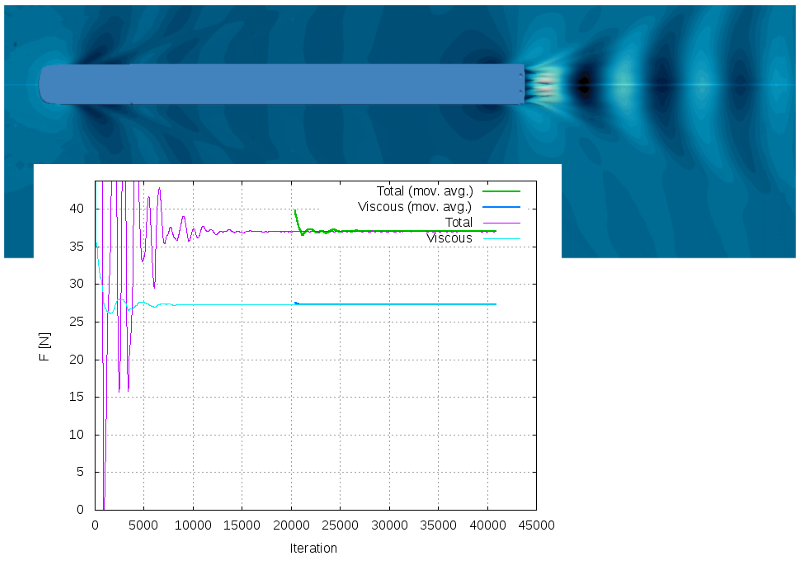
Ship Resistance Calculation with Open-Source CFD: The InsightCAE Framework
Hydrodynamic optimization of ships is one of the central challenges in modern shipbuilding. Low ship resistance reduces fuel consumption, lowers CO₂ emissions, and improves the overall operational economy. At the same time, the precise calculation of ship resistance traditionally requires deep expertise in Computational Fluid Dynamics (CFD) as well as costly commercial software licenses.
With our InsightCAE Framework, we offer fully automated ship resistance calculations using exclusively open-source CFD software. This not only eliminates software license costs, but also enables users with little specialized knowledge to perform the rather complex CFD analyses independently thanks to the automation.
What is ship resistance calculation?
Ship resistance, also known as hydrodynamic resistance, describes the sum of forces that oppose the forward motion of a ship. It is composed of various components: viscous friction resistance, pressure resistance, and wave-induced resistance (wave-making resistance). For a realistic simulation, free surface effects, trim, and squat must be considered—tasks that can be reliably solved with modern CFD methods.
CFD Simulations in Shipbuilding: Open Source Instead of Proprietary Software
For flow simulations in shipbuilding, Reynolds-averaged Navier-Stokes (RANS) equations are typically used, combined with suitable turbulence models like k-ω SST. The InsightCAE Framework utilizes proven open-source tools for this purpose, such as OpenFOAM, one of the most powerful freely available CFD packages worldwide. The elimination of commercial license costs—which can quickly reach five to six figures annually with programs like STAR-CCM+ or ANSYS Fluent—makes high-quality ship hydrodynamics simulations economically accessible even for smaller engineering firms, shipyards, and research institutions.
Fully automated workflow: From geometry to results
The decisive advantage of the InsightCAE Framework lies in its end-to-end automation:
- Geometry ProcessingAutomatic preparation and meshing of ship geometry based on standardized input formats
- Boundary conditions & physical modelsAutomatic configuration of speed, shallow water depth, loading condition, and environmental conditions
- Solver ControlFully automatic start, monitoring, and convergence check of CFD simulation
- Evaluation & ReportingAutomated extraction of resistance components and creation of meaningful reports
This workflow enables efficient and reproducible serial parameter studies, for example, for optimizing hull shape, bulbous bow, or stern geometry.
The InsightCAE Framework is suitable for:
- Naval architects and design offices, who want to integrate CFD analyses into early design phases
- Shipyards, who want to build internal simulation capabilities without high licensing costs
- Research and Teaching, where open-source accessibility and transparency of methods are particularly important
- Operators and shipping companies, to analyze existing ships for efficiency or to evaluate retrofits
Conclusion
The combination of open-source CFD, intelligent automation, and low barriers to entry makes the InsightCAE Framework a forward-thinking solution for numerical ship hydrodynamics. High-quality ship resistance calculations are no longer the domain of a few specialists, but rather an accessible tool for anyone who wants to design ships that are more efficient, economical, and sustainable.