

The Seaway Calculation is a central element of ship design and forms the basis for assessing the behavior of ships and floating structures in real sea conditions. It provides crucial information for safety assessment and operational planning.
What is seaway analysis and why is it important?
Seakeeping refers to the dynamic forces generated by wind, waves, and currents to which a ship is exposed at sea. A well-founded seakeeping analysis allows for precise prediction of a ship's motion behavior as early as the design phase – before the keel is laid. This minimizes costly post-construction corrections and increases onboard safety.
Potential codes as the basis for seaway calculation
The analysis of wave calculations is usually done using Potential Codes performed. This method is based on potential flow theory and allows for a fast, numerically stable calculation of the hydrodynamic forces acting on a ship hull. Potential codes assume an incompressible, inviscid, and irrotational flow – assumptions that are well justified for seakeeping calculations in many practical cases.
Response Amplitude Operators (RAOs): The Heart of Motion Analysis
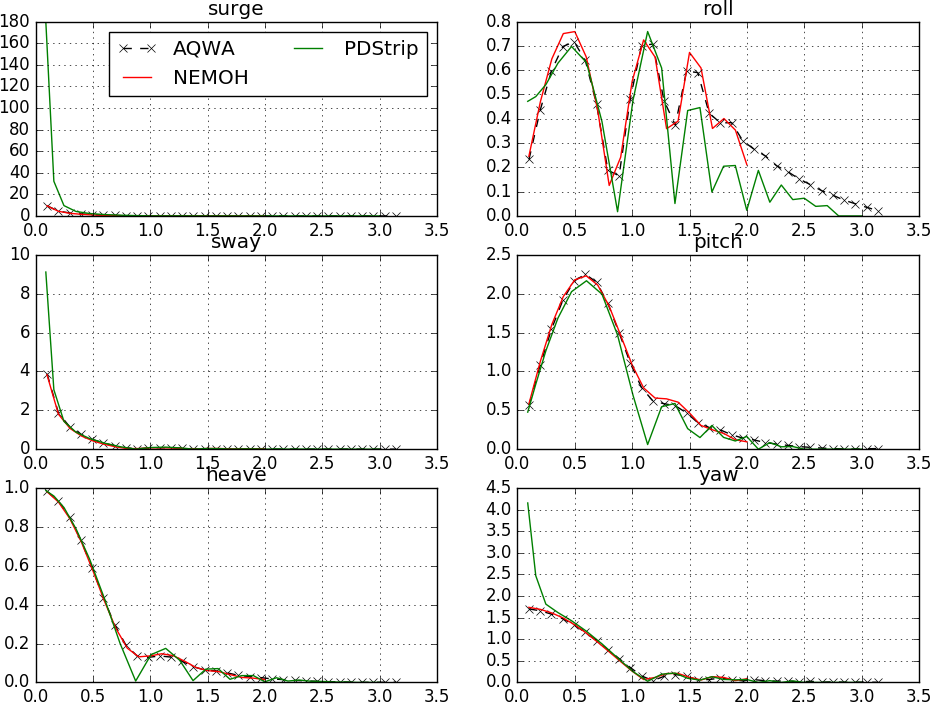
The core of wave state calculation is determining the Response Amplitude Operators (RAOs) – also called transfer functions – for all six degrees of freedom of the ship:
- Surge Longitudinal movement
- Sway Wobble movement
- Heave – Hub movement
- Roll Rolling motion
- Pitch Tamping motion
- Yaw – Gear movement
RAOs describe how strongly a ship reacts to a wave of a specific frequency and direction. They are frequency-dependent and are determined for different ship speeds and wave heading angles.
Derived parameters: Accelerations, velocities, and seasickness criteria
From these RAOs, a variety of practice-relevant characteristic values are subsequently calculated at arbitrary locations on the ship:
- Accelerations (e.g., at workplaces, crane locations, or load securing points)
- Speeds ship motion in various sea state scenarios
- Frequency criteria for seasickness Motion Sickness Incidence, MSI
- Relative Movements and Freeboard for evaluating green water events
- Operability indices for safe use under specific sea state conditions
These results directly feed into ship design, equipment layout, and the planning of offshore operations.
Simulation with Open-Source Tools: PDStrip and NEMOH
The simulations are being conducted with the proven Open-Source Tools PDStrip or NEMOH performed
- PDStrip is a 2D strip theory code that is particularly well-suited for slender ship hulls and is characterized by high computational speed. It is ideal for initial design iterations and parametric studies.
- NEMOH is a 3D potential flow panel code based on the Boundary Element Method (BEM). It is particularly well-suited for complex geometries, floating offshore structures, and cases where 3D effects cannot be neglected.
Both tools are established in the scientific and engineering communities and benefit from active further development by research institutions worldwide.
Seamless integration into ship resistance analysis
A key advantage of our approach: the required input for wave calculation is fully compatible with the input for our ship resistance analysis. This means that geometry data and vessel parameters, once processed, can be directly used for both analysis types. This significantly reduces effort and ensures a consistent data foundation throughout the entire design process.
Conclusion: Professional sea state calculation for safer and more efficient ships
Precise seakeeping analysis is essential for modern ship design. Using potential flow codes, RAO-based motion analysis, and powerful open-source tools like PDStrip and NEMOH, well-founded statements about a ship's seakeeping behavior can be made early in the design process. The close integration with resistance analysis makes our workflow particularly efficient.
Do you have questions about wave load calculation for your project? Contact Us – we are happy to advise you.