

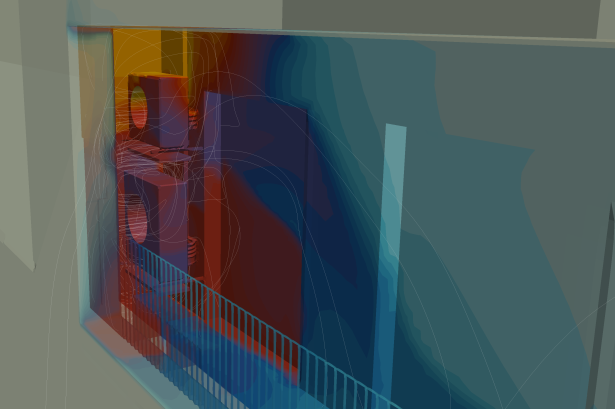
Numerical simulation of temperature distribution and climate control enables precise, data-driven planning of rooms and halls – even before the first groundbreaking or the next renovation. With the help of modern CFD (Computational Fluid Dynamics) methods, thermal weak points can be identified early and remedied effectively.
What can thermal building simulation achieve?
Our simulation solutions cover the entire spectrum of thermal and fluid flow analysis:
- Visualization of thermal bridges Critical areas in facades, roofs, and connections become visible before they lead to structural damage or energy loss.
- Overheating analysis – Taking wind direction, solar radiation, and seasonal climate data into account, the thermal behavior of buildings is realistically calculated.
- Energy optimization of room ventilation Targeted adjustment of air supply and exhaust systems to ensure healthy indoor air and efficient energy use.
- Hall ventilation and industrial ventilation Especially in large production and warehouse halls, well-thought-out air flow is crucial for occupational safety and system performance.
InsightCAE Add-On for Building Ventilation Simulation
The specially developed InsightCAE Add-On for Building Ventilation Simulation offers a powerful and user-friendly environment for the complete simulation chain – from geometry to results.
- Interactive Geometry Creation from existing 2D plans or BIM data (Building Information Modeling) - without complex manual modeling.
- Seamless integration into existing planning and engineering workflows.
- Developed in close collaboration with a major industrial client - practical, tested, and aligned with real-world requirements.
Why numerical simulation instead of traditional planning?
Conventional calculation methods quickly reach their limits with complex building geometries, variable climatic conditions, or industrial requirements. Numerical flow and thermal simulation, on the other hand, provides:
- Spatially resolved temperature and flow fields in 3D
- Quantitative Evaluation of Different Ventilation Concepts in Direct Comparison
- Understandable, documentable results for building permits, certifications, and energy performance certificates
- Early error avoidance and cost reduction through virtual optimization
Typical use cases
Thermal building simulation is used for:
- Industrial and production halls with high heat load
- Office and administrative buildings with proof of summer heat protection
- Data centers and server rooms with critical temperature requirements
- Sports venues, exhibition centers, and public buildings with large room volumes
- Building envelopes in the context of energy-efficient renovation planning
Request consultation now
Are you planning a new construction project, a renovation, or do you want to optimize the air conditioning of your existing property? Contact Us – we analyze your requirements and show you how numerical simulation saves time, costs, and energy.