

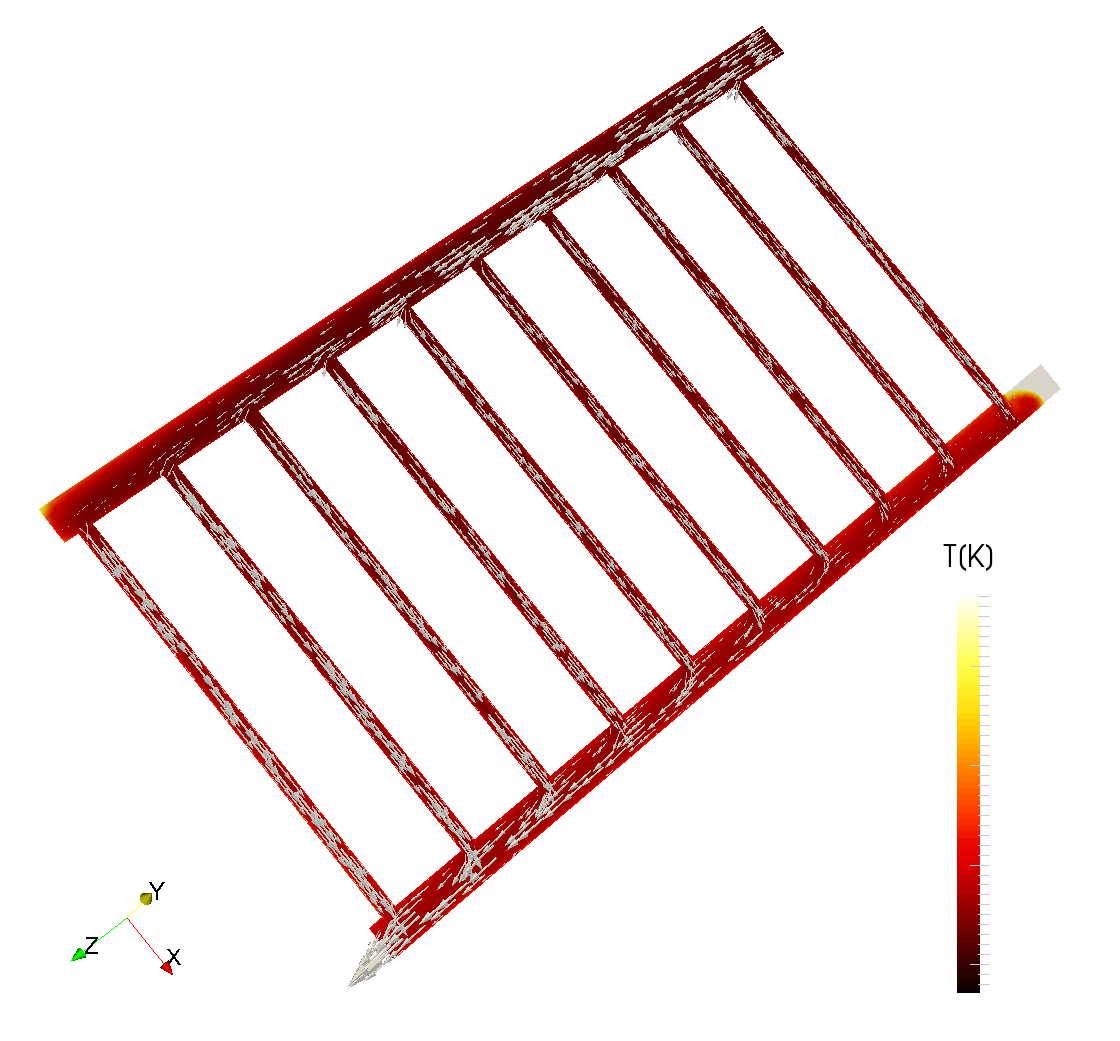
The efficiency of a solar collector depends on a variety of interacting physical influencing factors – solar radiation, ambient temperature, wind speed, collector geometry, flow guidance, and heat transfer to the carrier medium. A purely experimental design is costly and time-consuming, providing only isolated insights. Numerical fluid dynamics and heat transfer simulation (CFD), on the other hand, enables a complete, spatially resolved analysis of thermal and fluid mechanical behavior – for any operating conditions and collector configurations.
Thermal Simulation: Warm-up Under Real Operating Conditions
We determine the heating of the heat transfer fluid in solar collectors, taking into account all relevant environmental influences – steady-state for design operating points as well as transient for mapping daily and seasonal fluctuations:
- Solar irradiance – Variation of global solar radiation from cloudy conditions to maximum direct radiation; consideration of the angle of incidence depending on collector tilt, geographical location, and time of day
- Outside temperature – Influence of ambient temperature on heat losses through the cover glass, frame, and back of the collector; simulation of seasonal operating points from winter to midsummer
- Wind speed and direction – convective heat losses on the collector surface due to airflow; identification of critical wind exposure areas and aerodynamic pressure distributions
- Heat loss analysis – Quantification of losses due to convection, radiation, and heat conduction to determine thermal efficiency
Flow Engineering: Flow Rates and Pressure Losses
Besides thermal performance, the hydraulic design of the collector is crucial for system efficiency and operational reliability. Uneven flow through the absorber channels leads to local overheating, increased wear, and reduced heat yield. We simulate and optimize:
- Flow rate distribution – Uniform flow through all absorber pipes or channels as a basic prerequisite for maximum thermal efficiency; Identification and remediation of flow imbalances
- Pressure drop calculation – Determination of the total pressure loss across the collector as the basis for the design of the circulation pump and the piping system
- Channel Geometry and Absorber Design – Comparison of different fin geometries (harp fins, meander fins, plate absorbers) with regard to pressure drop and heat transfer efficiency
- Influence of the heat transfer medium – Water, water-glycol mixtures, or special fluids with temperature-dependent material properties
Collector types and areas of application
Our simulation methods are applicable to all common solar collector technologies.
- Flat-plate collectors – the most widespread collector type for hot water heating and heating support; simulation of the glass cover, absorber plate, and insulation layer
- Vacuum tube collectors - Higher efficiency with diffuse radiation and low outside temperatures; flow and heat simulation in the annulus and heat pipe
- Concentrating Collectors (CPV/CSP) – Parabolic troughs, Fresnel collectors, and dish systems for process heat and solar thermal power plants
- Air collectors – direct heating of air as a heat transfer medium for drying systems, building ventilation, or agricultural applications
Solar collector simulation request
Are you developing a new collector, optimizing an existing design, or planning a collector field for an industrial or building application? Speak to us – we support you with precise CFD simulation from the initial concept to series production design.