

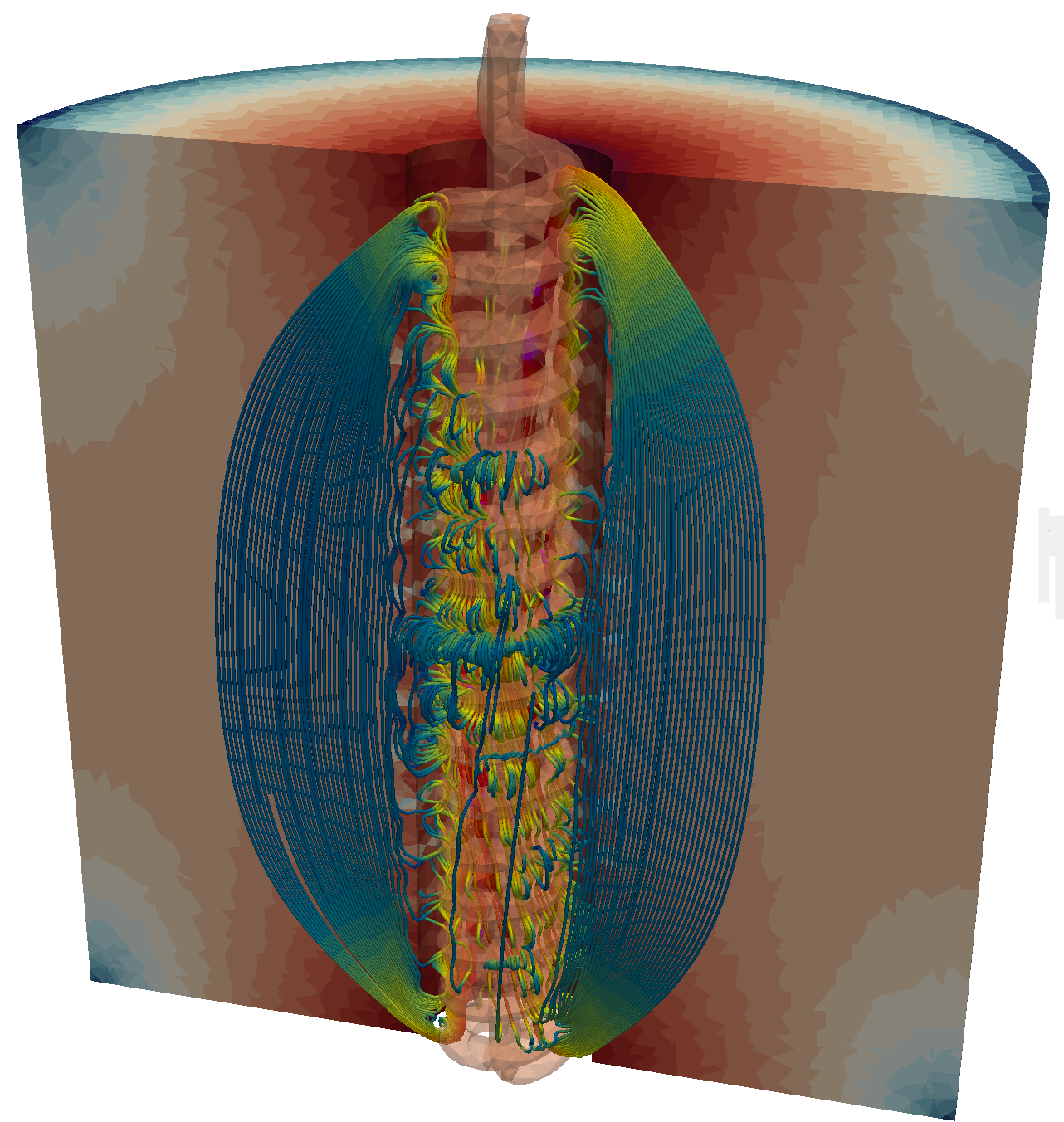
Inductive heating is an established and highly efficient process in modern manufacturing and process engineering. Whether hardening, brazing, shrinking, or targeted heat treatment – the contactless, rapid, and locally precise heat input makes induction heating the method of choice in numerous industries. However, the underlying physical interactions between the electromagnetic field, induced current, and resulting heat distribution are complex and difficult to predict without numerical simulation.
We simulate inductive heating processes for technical components made from various materials – in 2D and 3D, including surrounding media. We combine electromagnetic field simulation with Elmer and the heat transfer calculation with OpenFOAM to a powerful, coupled multiphysics simulation – integrated into our software environment InsightCAE.
What does inductive heating simulation achieve?
Numerical simulation of induction heating allows for a complete, physically consistent description of the heating process – from coil geometry to the temperature distribution in the component and its surroundings:
- Calculation of the electromagnetic field distribution – Magnetic field strength, current density, and eddy current losses as a function of frequency, coil geometry, and material parameters
- Spatial distribution of heat sources local heat input derived from Joule losses as the basis for thermal analysis
- Stationary and transient heat propagation – Temperature trends over time and space, cooling behavior, thermal gradients, and hot spots
- Environmental influence – Heat conduction into adjacent components, radiation, and convection at surfaces are fully accounted for
- Material Nonlinearities – temperature-dependent electrical conductivity, heat capacity, and thermal conductivity are correctly represented
Coupled Multiphysics Simulation: Elmer + OpenFOAM in InsightCAE
The physical peculiarity of inductive heating lies in the close coupling of electromagnetics and heat transport. Both domains influence each other: the electromagnetic field determines the heat sources, while the temperature changes the material-dependent electromagnetic properties. This bidirectional coupling requires specialized simulation tools.
- Elmer (FEM) resolves the Maxwell equations for electromagnetic field simulation, calculates eddy currents and Joule loss power in the component and its surroundings
- OpenFOAM (FVM) – handles the heat transfer calculation, maps stationary and transient temperature fields, and considers conduction, convection, and radiation
- InsightCAE – our own simulation environment coordinates the data exchange between both solvers, manages the coupling steps, and provides an end-to-end workflow environment from geometry preparation to result evaluation
2D and 3D Simulations – Materials and Geometries
Depending on the complexity of the task, we use rotationally symmetric 2D models for rapid parameter studies or complete 3D models for geometrically complex components and asymmetric coil arrangements. Components made of:
- Steels and special steels – ferromagnetic and austenitic, with and without phase transformation
- Aluminum and copper alloys – high electrical conductivity, low skin effect at high frequencies
- Titanium-based alloys - relevant for aerospace and medical technology
- Composite materials and multilayer systems – e.g., coated components or cast-in inserts
Typical applications of induction heating simulation
The simulation of inductive heating processes is crucial in a wide variety of processes and industries:
- Induction hardening – Prediction of hardening depth, temperature profiles, and quenching behavior for gears, shafts, and bearing rings
- Induction soldering and welding Optimization of heat input for reproducible bonded joints
- Shrink fits – Thermally controlled expansion of hubs and rings for mounting press fits
- Preheating before forming – Forging, cold forming, or hot bending with targeted local preheating
- Plastics processing and composite materials – inductive heating of inserts or tools
- Test and Measurement Technology – non-destructive testing using eddy current testing
Advantages of numerical simulation over purely experimental approaches
- Visualization of internal temperature fields that are not accessible or only accessible with great effort through measurement.
- Systematic variation of coil geometry, frequency, power, and component position without physical prototypes
- Early identification of overheating zones, insufficient penetration depth, or uneven heating
- Reduction of development times and reduction of scrap and rework in series production
- Securing and Documenting Process Parameters for Quality Management and Certifications
Request induction heating simulation now
Do you want to optimize an induction heating process, design a new procedure, or test an existing component for thermal load capacity? Speak to us - We analyze your task and develop a customized simulation model using Elmer, OpenFOAM, and InsightCAE.