

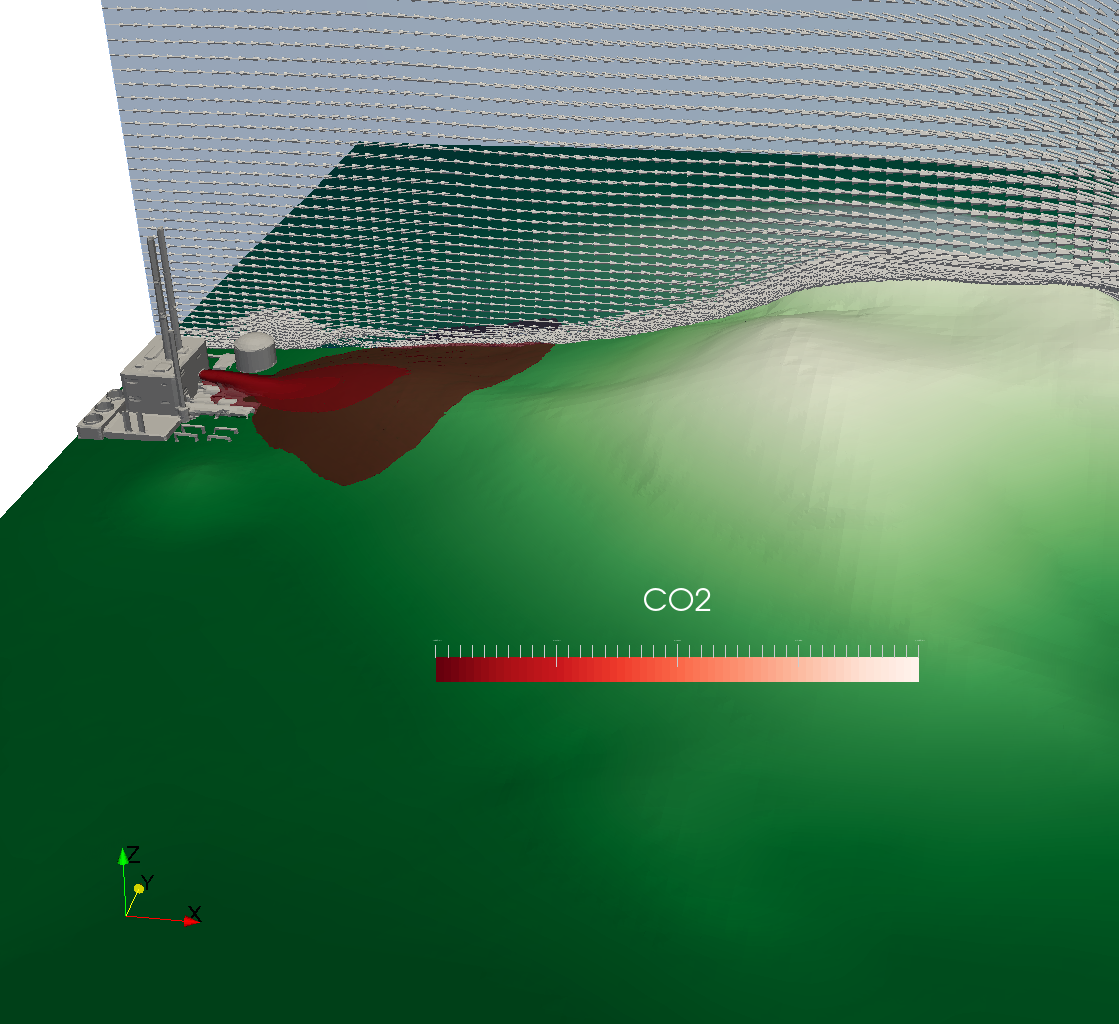
CFD simulation of gas dispersion in accident scenarios – Safety analysis for light and heavy gases
For industrial plants, chemical facilities, energy supply infrastructures, and safety-critical installations, the uncontrolled release of gases in the event of a malfunction poses a significant risk to people, the environment, and assets. The precise prediction of gas dispersion is therefore an essential component of modern safety analyses, risk assessments, and emergency planning.
Simulation-based Accident Analysis with CFD
Using CFD (Computational Fluid Dynamics) simulations, escaping gases in fault scenarios – both light gases (e.g., hydrogen, methane, ammonia) and heavy gases (e.g., chlorine, propane, CO₂) – are precisely captured in their spatial and temporal dispersion. The simulation takes into account the immediate surroundings (building contours, obstacles, terrain structure) as well as the distant surroundings (building density, topography, open areas) to model realistic dispersion scenarios.
Stationary and transient concentration fields
The calculation of both steady-state and transient concentration fields allows for a differentiated assessment of the dispersion dynamics:
- Stationary fields show the steady state under a constant leakage rate and provide information about permanently critical zones, explosion limits (LEL/UEL), and toxicity thresholds (e.g., ERPG, AEGL, or IDLH values).
- Transient fields depict the temporal course of the spread – from release through cloud formation to dilution – and are crucial for assessing evacuation periods and alarm concepts.
Influence of different wind directions and meteorological conditions
Wind direction, wind speed, and atmospheric stability classes (according to Pasquill-Gifford or Monin-Obukhov) have a significant influence on the range, concentration, and hazard zone of a gas cloud. By systematically varying these parameters, all safety-relevant scenarios are covered – from calm weather conditions with low mixing to turbulent flow with rapid dilution.
Transient Inflow Boundary Conditions in Atmospheric Boundary Layers
An essential quality feature of the simulation is the use of custom-developed transient inflow boundary conditions for atmospheric boundary layers. In contrast to simplified wind profiles, realistic, time-varying flow profiles with turbulent boundary layer structure are used. This ensures a high degree of agreement with real meteorological conditions and significantly increases the reliability and validity of the simulation results – a crucial advantage over classic Gaussian dispersion models.
Application areas and regulatory framework
CFD-based gas dispersion simulation is used in:
- Accident Prevention Ordinance (12. BImSchV) / Seveso III Directive: Proof of safe distances and safety zones
- Safety reports and QRA (Quantitative Risk Assessment): Basis for probabilistic risk assessments
- Fire and disaster control planning: Support for deployment scenarios and evacuation planning
- Facility Planning and Approval Procedures Early identification of critical spread pathways