

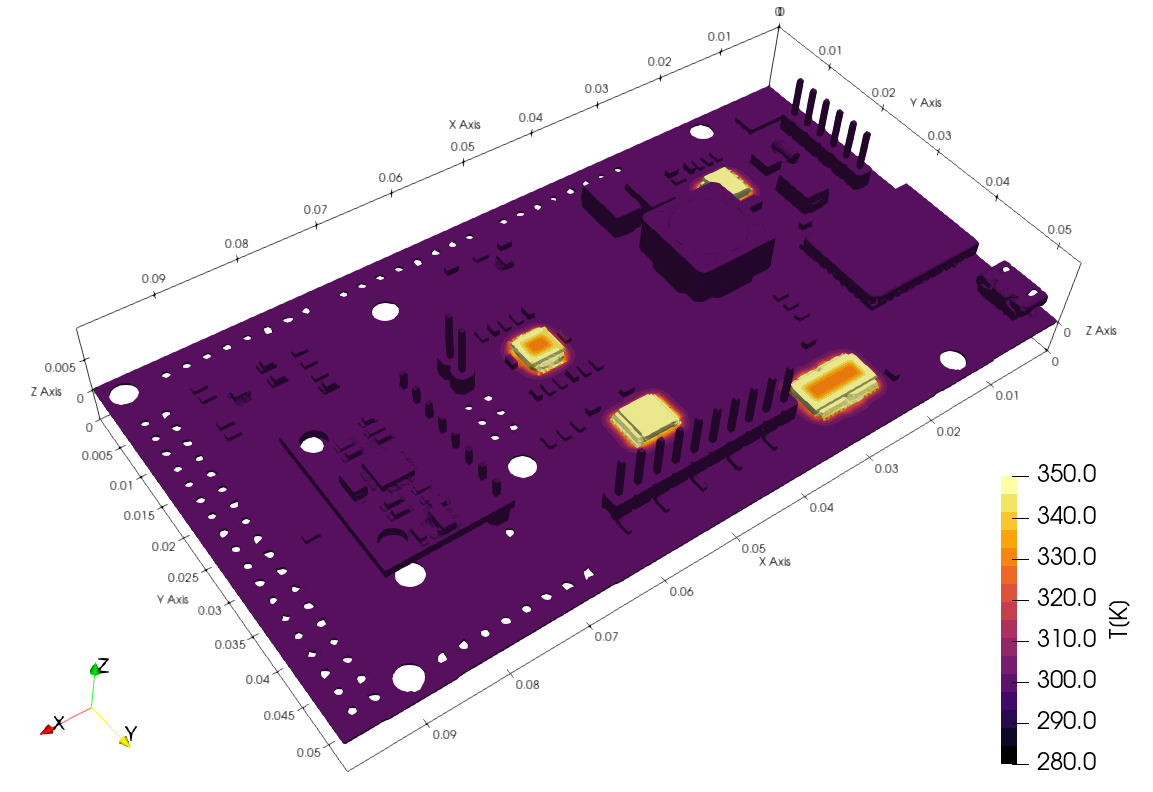
Thermal Simulation and Thermal Management in Electronics and Lighting Development
In modern development processes, thermal management is a central challenge – especially for high-performance components such as electronic assemblies, power electronics, and LED light sources. Using 3D CFD (Computational Fluid Dynamics) simulations and FEM (Finite Element Method)-based thermal analysis, precise thermal analysis is performed for the cooling of various components, including electronics, light sources, and embedded systems.
Heat transfer mechanisms in detail
A realistic simulation considers all relevant heat transfer mechanisms:
- Heat conduction (conduction): The quantification of heat conduction through solid materials such as printed circuit boards (PCBs), heat sinks, and housing materials enables the targeted selection of thermally optimized materials and material composites.
- Thermal radiation Calculating emitted infrared radiation based on emissivity and surface temperatures is particularly relevant at high operating temperatures and in a vacuum.
- Free convection (natural convection): Without active cooling elements, air circulation is created solely by density differences in the heated fluid – ideal for silent, low-maintenance designs.
- Forced convection Fans, blowers, or pumps generate a defined flow of air or fluid and significantly increase heat transfer. Simulation allows for the optimization of flow guidance, duct geometry, and fan position.
Cooling concepts and their simulation-based evaluation
Various cooling strategies – from passive air cooling and active forced cooling to liquid cooling and heat pipes – are virtually evaluated before a physical prototype is created. Key performance indicators such as maximum component temperatures, temperature gradients, thermal resistances, and compliance with limit values according to IEC, JEDEC, or UL standards are crucial evaluation criteria.
Early Functionality Assurance in the Development Process
By integrating thermal simulation early in the development phases – from conceptual design through detailed design to series production readiness – costly redesigns and thermally induced failures can be avoided. The simulation provides reliable statements on service life, reliability, and compliance with temperature limits (e.g., Tjunction for semiconductors or Tc values for LED modules), which are directly incorporated into the design.
This ensures the product's functionality is reliably guaranteed during the development process – long before the first prototype.