Month: January 2022

  • Electronic cooling simulation using OpenFOAM

    Electronic cooling simulation using OpenFOAM

    Space limitations and high power supply requirements ultimately lead to innovative cooling designs for a wide range of PCBs. The arrangement of the power supply, heatsink dimensions, and the design of the outer housing become more important. Thermal simulations within the PCB design process help to overcome overheating problems in later production stages. 

    Different materials, the combination of heat conduction, convective, and radiative heat transfer within solids and air result in fairly complex thermal simulations. Setting up material properties, boundary conditions, solver settings, and coupling regions often takes a considerable amount of time.

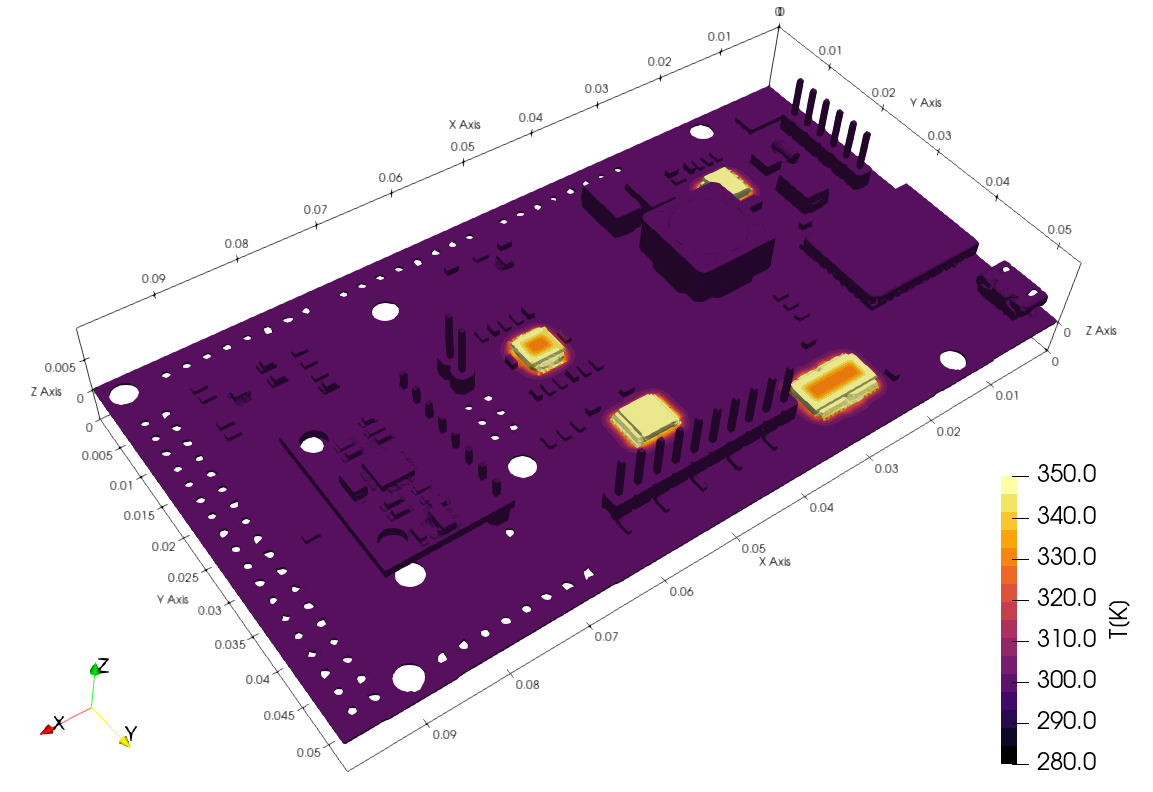
    As an example, a typical PCB with its components is presented.

    Simulación térmica 

    Silentdynamics has managed to bundle the simulation setup using OpenFOAM thermal solverschtMultiRegionFoamchtMultiRegionSimpleFoamwithin its framework InsightCAE for fast preprocessing.

    Importing CAD files for each component and its optimized parallel region meshing process using snappyHexMesh are essential for the conservative flux coupling of the different heating regions.
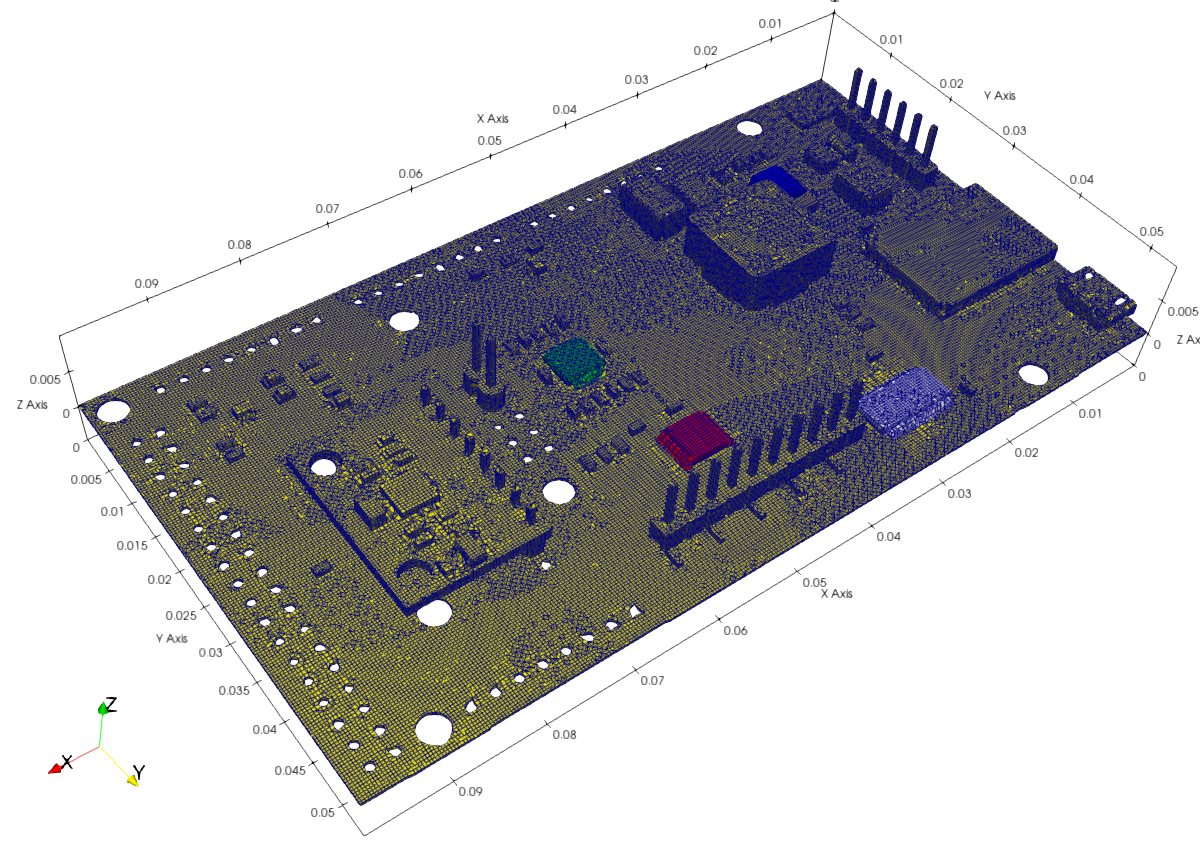
    Notice that the usage of different Vias, copper wires, heat conduction layers, or other heat-related points needs to be addressed in the simulation model. Using region modeling, cell sets, and layer definitions for each component allows for the consideration of all required thermal properties.

    Allowing for specially defined wildcards, CHT simulation setup is nearly automated. 

    Moreover, improved heat radiation handling and optimized solver settings form the basis of stable and convergent simulations. 
  • Degassing simulation using OpenFOAM

    Degassing simulation using OpenFOAM

    Space limitations and high cost pressures increasingly lead to more complex and smaller hydraulic tanks. This results in a dramatic reduction of air separation in the tank and, consequently, an increased amount of free air in the hydraulic system.

    In hydraulic systems, free air is still a technical challenge today. As long as the air is dissolved in the oil, it does not change its properties.

    On the other hand, undissolved air, i.e., air bubbles, cause:

    • Corrosion on pumps and controls
    • Increased compressibility of hydraulic fluid can reduce the efficiency of pumps and hydraulic motors, leading to possible stuttering movements of the output member.
    • Accelerated oil aging
    • varnish noise
    • Damage to the components (e.g. cavitation)
    • etc.

    Air enters the circuit during assembly, through leaks in the negative pressure zone, and as oil flows back into the reservoir. Depending on the separation capacity of the filter-tank system, the air in the tank only rises slowly and is then re-sucked by the pump.

    Simulation of air-liquid devices

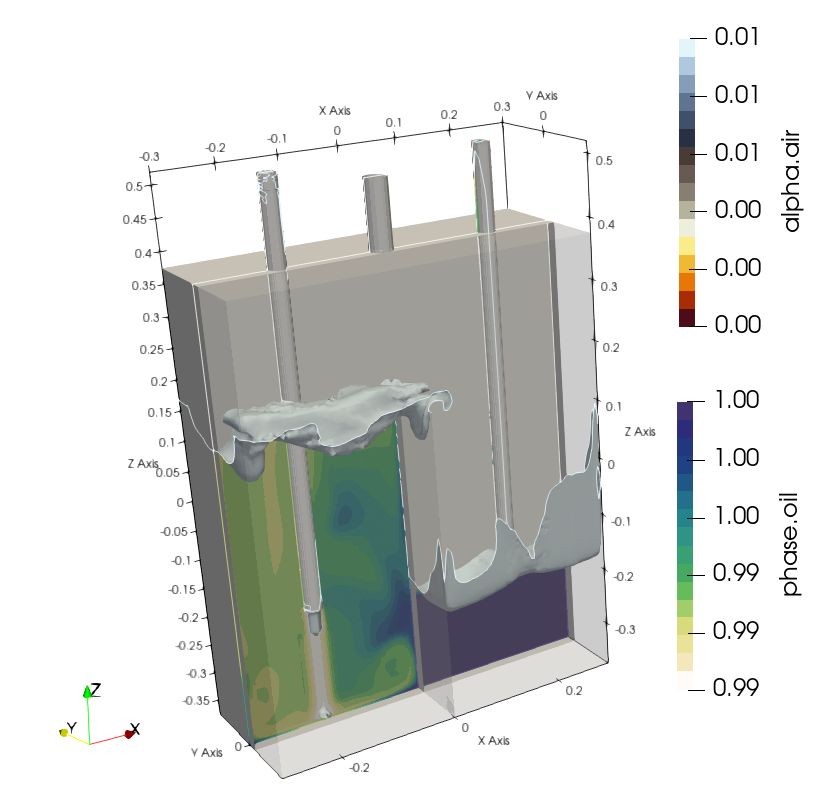
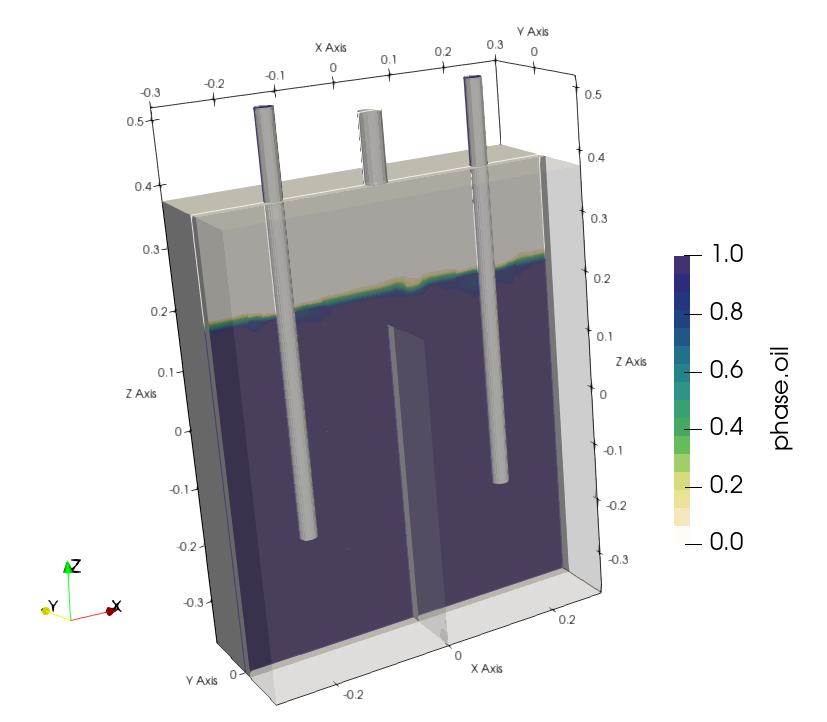
    Silentdynamics uses InsightCAE to perform a number of simulations of dispersed gas bubbles in a degassing tank. Application of the solver twoPhaseEulerFoam enables the transient tracking of the gas phase, integral values of air at the outlets, and overall the quality of the degassing device. 

    As an example, a simple degassing scenario is presented. There is one inlet and two outlets, with a weir located in the center. The oil-gas mixture flows over the weir for degassing.


    Setting up gas-oil dispersion boundary conditions such as gas bubble size, blending coefficients, and phase properties for the simulation using twoPhaseEulerFoam could be initiated.

    Using advanced solver settings within the InsightCAE framework, large time steps are enabled to manage simulations within a reasonable timeframe.

    Isosurfaces of 1% gas are presented. 


    Changing the degassing tank geometry using numerical simulation leads to a sufficient degassing process of the hydraulic oil.